
Home » Posts Page » Blog » Products and Materials » FIBC Testing Methods: What Happens Before a Bag Gets Certified
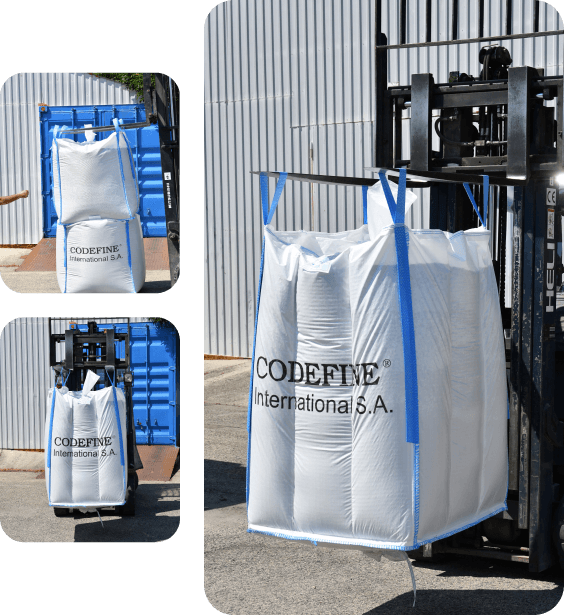
Before getting into individual tests, it helps to understand which standard applies to your application. Two frameworks cover the vast majority of commercial FIBC use.
ISO 21898 is the primary international standard for FIBCs used with non-dangerous goods. It covers materials, construction design, performance requirements, and marking. Most commercial bulk bag applications, food ingredients, agricultural products, construction materials, and standard chemicals fall under ISO 21898. The standard was updated in 2024 with stricter UV aging requirements and new stacking labeling obligations.
UN certification is required for FIBCs used to transport hazardous or potentially hazardous materials, flammable powders, toxic chemicals, and reactive substances. Governed by the UN Recommendations on the Transport of Dangerous Goods, UN-certified bags must meet a higher safety factor (6:1 rather than the standard 5:1), pass a more demanding test battery, and be recertified annually. UN certification is incorporated into international transport regulations, including IMDG for sea freight and ADR for road transport in Europe.
Beyond these two, application-specific standards add further requirements: IEC 61340-4-4 for electrostatic classification of anti-static bags (Types A through D), FDA/FSMA compliance for food-grade applications in the US market, and GMP standards for pharmaceutical use.
ISO 21898 | UN Certification | |
Applies to | Non-dangerous goods | Hazardous materials |
Safety factor | 5:1 minimum | 6:1 minimum |
Governing body | ISO | UN / national transport authorities |
Recertification | Design-based | Annual |
Key industries | Food, agriculture, construction, general chemical | Chemical, pharmaceutical, flammable materials |
Certification begins with type testing, a full set of physical tests performed on a new bag design before it enters production. The design must pass every applicable test before it can be certified and manufactured at scale. Once a design is certified, ongoing production may be subject to batch or periodic testing to verify that manufacturing consistency is maintained.
Testing must be carried out by accredited facilities with properly calibrated equipment meeting the relevant standards’ requirements. Not all testing facilities are equal, and a certification report that does not name an accredited third-party facility should be treated with caution. The safe working load marked on every certified bag is the load at which the design has been verified to perform across the full test battery.
Every certified FIBC must pass a defined set of physical tests. The table below summarises each one before the detailed explanations that follow.
Test | What It Verifies | Pass Criteria |
Top Lift | Lifting system integrity under maximum load | No deformation or loss of contents at 5× or 6× SWL for 5 min |
Stacking | Load-bearing capacity under stacked storage | No content loss or structural deterioration after 24 hours |
Drop | Impact resistance during handling accidents | No rupture or leakage after drop from the specified height |
Topple | Stability when a stacked bag falls over | No burst or leakage on impact |
Righting | Loop and seam integrity during recovery from tipped position | No damage to the bag or lifting devices after righting |
Tear | Tear propagation resistance in the bag fabric | Tear does not grow more than 25% of the original length under load |
Vibration | Structural integrity under sustained transport vibration | No rupture or leakage after 60 minutes |
The top lift test is the most critical evaluation of an FIBC’s core function: its ability to be safely lifted when full. The bag is filled to its rated SWL capacity and suspended by its lift loops. A hydraulic cylinder then applies downward pressure on the contents, simulating the stress of a dynamic lift.
To pass, the bag must maintain a total load of 6× SWL for UN-certified bags, or 5× SWL for standard ISO applications, for a minimum of five minutes, with no permanent deformation and no loss of contents. Understanding the FIBC safety factor behind this test helps buyers appreciate how much engineering headroom sits between the rated capacity and the actual breaking point.
The stacking test evaluates whether a bag can withstand the compressive load of other filled bags placed on top of it during warehouse storage and transport , a situation every commercially used FIBC will encounter repeatedly.
The filled bag is placed on a flat surface, and a load equivalent to two similar filled bags is applied to the top for 24 hours. Pass criteria require no loss of contents and no structural deterioration over the full test period. ISO 21898:2024 added a new labeling requirement to this test: all certified FIBCs must now be clearly marked with their maximum stacking capacity, giving warehouse teams reliable guidance at the point of use.
The drop test simulates what happens when a filled bulk bag is accidentally dropped during handling by a forklift operator, during loading, or in a transfer operation. The filled bag is dropped from specified heights, with the height varying by packaging group and packing group classification. Critically, the drop is oriented to impact the most vulnerable part of the bag, typically a corner or base seam, rather than the most robust surface.
Pass criteria require that the bag shows no rupture and no content leakage after each drop. For UN-certified bags transporting hazardous materials, this test carries particular weight: a failed drop in the field means a potentially dangerous spill.
The topple test addresses what happens when a stacked filled bag tips over , either from instability during storage or from a vehicle movement during transport. The filled bag is placed on a platform that is progressively raised until it topples, and the bag impacts a flat smooth surface. The height of the topple varies by packaging group.
Pass criteria require no burst and no content leakage on impact. The test complements the drop test by evaluating a different failure mode: rather than a vertical drop onto the base or corner, the topple test simulates a lateral fall of the entire filled bag.
The righting test evaluates lift loop and seam integrity during a recovery operation , when a tipped bag must be lifted back to an upright position in the field. This is a common real-world scenario in warehouses and during loading operations, and one where loop failure would create a serious safety incident.
The filled bag is knocked onto its side, then lifted back to an upright position using only two lift loops, at specified lifting speeds. For bags with four lifting straps, righting must be performed using two lifting devices simultaneously. Pass criteria require no visible damage to the bag body or the lifting devices after the righting is complete.
The tear test evaluates the fabric’s ability to contain a tear rather than allow it to propagate catastrophically, a critical property for any bag that may encounter sharp edges, abrasive materials, or rough handling surfaces during its working life.
The filled bag wall is punctured with a knife at a 45-degree angle, creating a cut at least 100mm long at a point halfway between the base and the top level of the contents. A load of 2× SWL is then applied for five minutes. Pass criteria require that the tear does not grow more than 25% of its original length under this load. Evaluating FIBC fabric quality at the specification stage helps buyers understand what fabric weight and construction are needed to pass this test for their application.
The vibration test simulates the sustained mechanical stress of road and sea transport, the kind of continuous low-frequency vibration that a bulk bag experiences over a multi-day journey. The filled bag is placed on a vibrating platform and subjected to 60 minutes of progressively increasing vibration, reaching a frequency high enough to cause the bag to lift from the platform surface.
Pass criteria require no rupture and no leakage after the full 60-minute test. This test is required for all UN-certified bulk bags and is one of the more demanding evaluations in the battery; bags that pass it have demonstrated real-world transport durability, not just static load capacity.
Beyond the seven core tests, certain applications require additional certification testing:
UV resistance, ISO 21898:2024 added a 1,500-hour UV aging test for FIBCs intended for outdoor storage. Post-aging breaking strength must retain at least 50% of original values. This matters for agricultural, construction, and port storage applications where bags may be exposed to sunlight during use.
Electrostatic classification, Anti-static bulk bags used with flammable or explosive materials must be tested and classified per IEC 61340-4-4. The standard defines four types (A through D) based on their electrostatic properties, and each type must pass specific tests verifying surface resistance and charge dissipation. Understanding the difference between Type C and Type D bags is particularly important for buyers in chemical and powder-handling industries.
Food-grade compliance, Food-grade FIBCs require material hygiene testing, migration testing to verify no odor or chemical transfer to the product, and regional compliance documentation, FDA 21 CFR 177.1520 for the US market, EC 1935/2004 for the EU.
Fabric and material testing, before a bag is assembled, the raw materials, woven PP fabric, seam thread, coating film, are tested for tensile strength, GSM verification, UV stabilizer content, and seam integrity. These upstream tests are the foundation on which the physical bag tests rest.
A supplier who stands behind their certification should be able to provide a complete documentation package without hesitation. Here is what a legitimate package contains, and what to look for when evaluating it.
Test report from a named, accredited testing facility. The report should identify the testing organization, confirm its accreditation, and list the standard under which tests were conducted. A report without a named facility or with vague references to “internal testing” cannot be independently verified.
Safety factor and SWL confirmation. The documentation should clearly state the bag’s safe working load and the safety factor applied, 5:1 for standard ISO bags, 6:1 for UN-certified. These must match the markings on the physical bag label. The UN markings on FIBC bags encode key compliance information and should be legible and consistent with the documentation supplied.
Standard reference. ISO 21898, UN certification number, IEC 61340-4-4 classification, food-grade compliance reference, whichever applies to your application, should be explicitly cited in the documentation.
For UN-certified bags: valid certification date and recertification schedule. UN certification expires annually. A supplier offering UN-certified bags should be able to confirm the current certification period and provide evidence of ongoing compliance.
For food-grade applications: Declaration of Conformity and applicable migration testing results. These confirm that the bag materials meet food contact safety requirements in your target market.
Red flags worth noting: certification claims without a named testing facility; self-certified quality declarations without third-party verification; certifications that reference a different bag specification than the one being supplied; and pricing significantly below market rates, which sometimes indicates shortcuts in the testing and certification process. Working with an established FIBC manufacturer rather than an intermediary is one of the most reliable ways to ensure that certification claims are backed by genuine manufacturing and testing controls.
At Codefine, certification is a manufacturing discipline, not a one-time exercise. Every FIBC design is type-tested to the applicable standard before entering production, and manufacturing consistency is maintained through structured quality controls at every stage: material sourcing, weaving, seam construction, and assembly.
We provide full certification documentation with every order, including test reports, safety factor confirmation, SWL verification, and application-specific compliance documentation for food-grade, UN, and anti-static specifications. Our team works directly with procurement and quality managers to ensure the right certification level is specified for each application, and to support buyers through the documentation process when required.
If you’re evaluating a new FIBC supplier, verifying an existing certification, or specifying bags for a regulated application, we’re ready to help. Contact Codefine to request certified samples or a full documentation package, or get a quote tailored to your specifications.
What is the difference between ISO 21898 and UN certification for FIBCs?
ISO 21898 is the primary international standard for FIBCs used with non-dangerous goods, covering design, materials, and performance requirements. UN certification applies to FIBCs transporting hazardous materials and requires stricter testing, a higher 6:1 safety factor, and annual recertification. Both require physical testing by accredited facilities.
How many tests does an FIBC need to pass to get certified?
For UN certification, a bag must pass seven core tests: top lift, stacking, drop, topple, righting, tear, and vibration. ISO 21898 requires a subset of these depending on bag design and application. Additional tests apply for UV resistance, electrostatic classification, and food-grade compliance.
What does a 5:1 or 6:1 safety factor mean in FIBC testing?
The safety factor is the ratio between the bag’s breaking strength and its safe working load. A 5:1 safety factor means the bag must withstand five times its rated SWL before failure, the standard for single-trip commercial FIBCs. UN-certified bags require a 6:1 safety factor due to the higher risks associated with hazardous materials.
How often do UN-certified FIBC bags need to be recertified?
UN certification is typically valid for one year and must be renewed annually. Recertification is also required if production processes, materials, or cargo properties change during the certification period.
Can I trust a certification claim without seeing the test documentation?
No. A legitimate certification should be supported by a test report from a named, accredited testing facility, referencing the applicable standard, safety factor, and SWL. A bag described as “certified” without supporting documentation cannot be independently verified.
See how our products can improve your operations and drive your success.
Get in touch to find out how Codefine can support your business with tailored solutions and expert guidance.