
Home » Posts Page » Blog » Products and Materials » FIBC Quality Control: What to Ask a Manufacturer Before Placing a Bulk Order
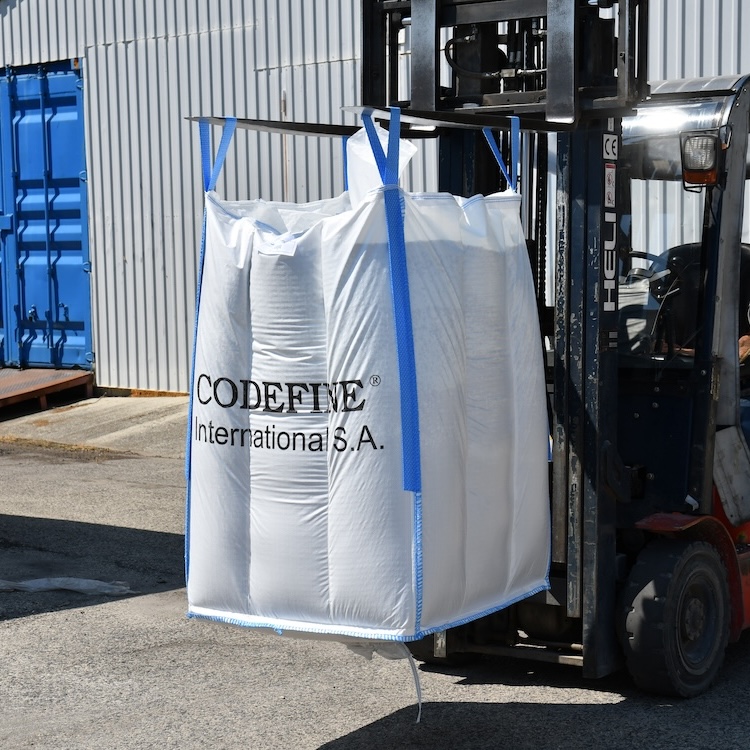
Quality control in FIBC manufacturing runs through raw materials, weaving tension, seam construction, and the paperwork tying a specific test result to the bag in front of you. Skipping any check replaces proof with blind trust, creating failures months later under untested loads.
This checklist covers the questions worth asking before you sign a bulk order, whether you’re comparing quotes or vetting a new FIBC bulk bag supplier for the first time.
“We inspect every bag” is a start, not a conclusion after a quality assessment. Real quality control begins before weaving, requiring batch-specific resin specs and a statement of conformity alongside the original design approval.
Weaving density, coating thickness, and stitch tension directly alter strength and dust permeability long before any damage becomes visible. Seam and loop construction carries almost the entire load path. A looser stitch density on one production shift creates a real difference in failure point between two batches that look identical.
Ask when the design was last re-tested, not just whether it was ever tested. A bag approved two years ago, before a resin or stitching change, is a certificate for a product that may no longer exist in that form.
Not every certification proves the same thing. Knowing which one applies to your product keeps you from overpaying for compliance you don’t need or under-specifying a bag that does.
A general FIBC certification doesn’t cover food-contact or static requirements. Ask for each certificate separately.
The top lift test matters most: a sample is filled to its rated safe working load, lifted, and held, checked for seam separation or loop detachment. The cyclic version required under current ISO 21898 lifts and lowers the bag thirty times to mimic repeated handling, as it happens in real-life scenarios.
Drop and stacking tests check separate failure modes: a fall from height versus the weight of bags stacked above. Ask whether testing happened at an accredited lab under ISO/IEC 17025, and whether the load cell used has been calibrated recently. A supplier with nothing to hide answers this in a sentence.
There are plenty of FIBC quality control questions to ask, especially when buying in bulk. Still, stick to the ones below to get the important information from your manufacturer and supplier.
|
Question Area |
What to Ask |
|
Raw materials |
Statement of conformity for this specific batch? |
|
Certifications |
Which standards apply to my product, specifically? |
|
Testing |
Single-lift or cyclic top lift, and tested when? |
|
Lab accreditation |
In-house or accredited third-party lab? |
|
Traceability |
Does every bag carry a batch number? |
|
Labeling |
Manufacturer ID, SWL, safety factor, manufacture date? |
|
Pilot batch |
Will you test a pilot run before full production? |
Each answer must be precise and specific – no cryptic responses, no riddles, and no mouthful explanations that mean nothing.
A safe working load quoted without an explanation of how it was tested requires a second look. A common benchmark is a 5:1 safety factor, meaning a bag rated for 1,000 kg was tested to 5,000 kg. If a supplier can’t connect their number to an actual test load, it may be a fabric-weight calculation rather than a tested result.
Watch for reluctance around facility visits, vague batch traceability (“we’ll check the whole order” instead of isolating a lot number), and a supplier who treats every certification as automatically bundled. ISO 21898, UN approval, static classification, and food-contact certification each answer a different question. A confident manufacturer can tell you which one your product actually needs.
Chemical shipments involving combustible powders should push hardest on static classification and conductive container liner fit. Food and pharmaceutical buyers need migration testing and food-contact documentation front and center, since mechanical certification alone says nothing about product safety. Mining and construction operations tend to weight drop and stacking performance, along with UV stability for outdoor storage, over the food-contact questions that matter elsewhere.
Same seven questions, different weighting, depending on what the bag needs to survive.
You don’t need to be a materials engineer to ask and expect answers on the FIBC quality control questions. Even as a casual buyer, you must ask for documents instead of accepting reassurance. A batch-specific conformity statement, a recent accredited test report, and a clear answer on which certifications apply are signs of a system that holds up. Vague answers on any of those are information, not an inconvenience.
Codefine’s FIBC specialists can walk through testing reports and batch documentation before your next production run ships.
What certifications should every FIBC manufacturer provide?
ISO 21898 at minimum. Beyond that, it depends on the product: UN approval for dangerous goods, IEC 61340-4-4 for combustible powders, and FDA or EU food-contact certification where relevant. No single certification covers all four.
How do I know if a safe working load rating is real?
Ask how it was tested and by whom. A tested rating comes from an accredited lab and includes a documented safety factor, commonly 5:1. A rating based only on fabric-weight math is weaker grounds for a bulk order.
What’s the difference between a design certification and a batch certification?
A design certification confirms a bag design passed testing once, possibly years ago. A batch certification confirms the materials in your specific shipment still match that design.
Why does traceability matter if bags pass inspection?
Visual inspection misses internal seam strength and fabric consistency across a run. Batch traceability lets you isolate a defect to one lot instead of pulling an entire shipment.
Do food and chemical applications need different QC questions?
The mechanical testing questions stay the same. What changes is the added layer: static and conductive testing for combustible chemicals, migration testing for food and pharma.
See how our products can improve your operations and drive your success.
Get in touch to find out how Codefine can support your business with tailored solutions and expert guidance.