
Home » Posts Page » Blog » Products and Materials » Warehousing Bulk Bags: Stacking Limits, Space Efficiency, and Safety
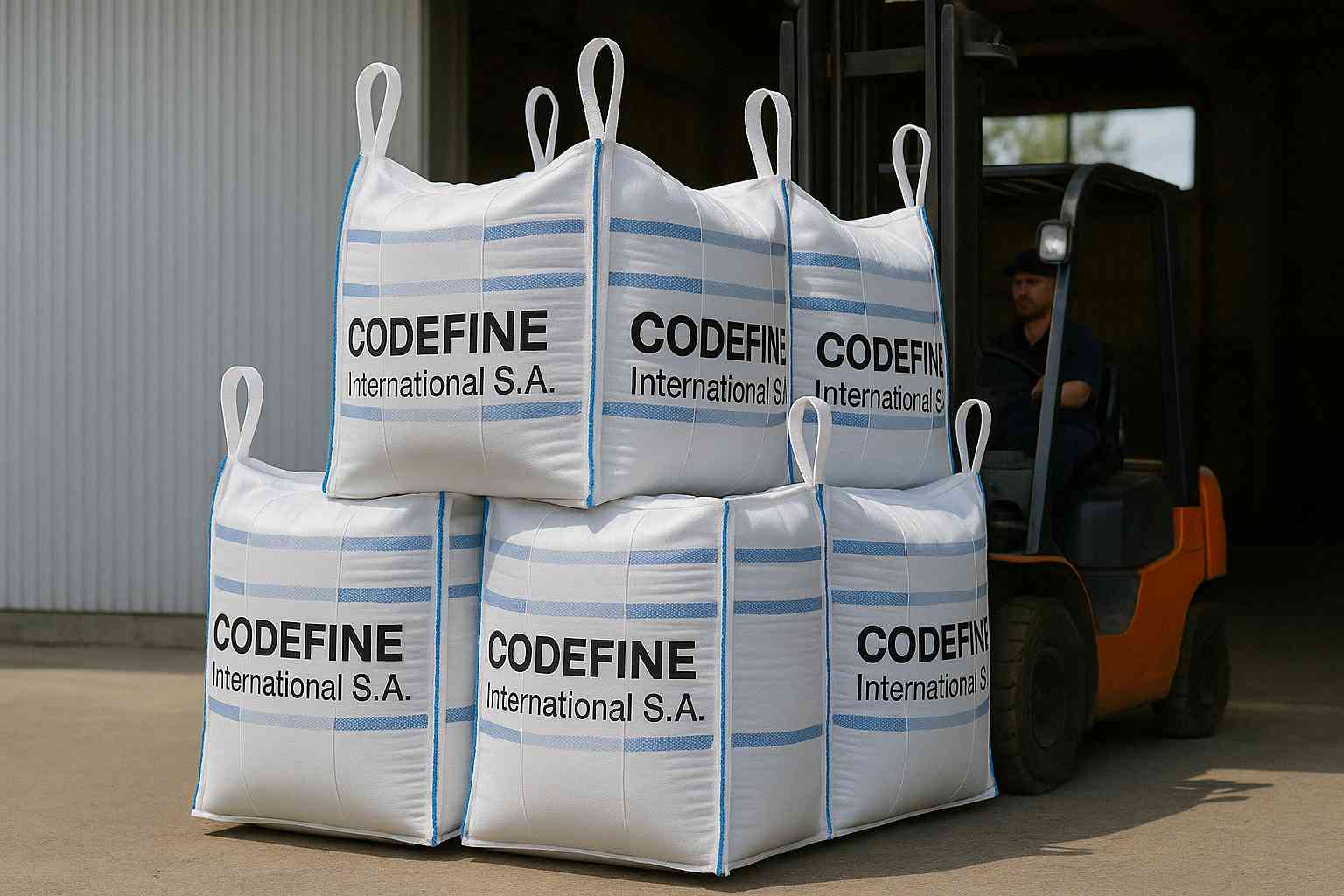
A bag rated for the correct working load can still tip, sag, or fail if the stacking height does not match its geometry, safety factor, or floor arrangement. Getting this wrong shows up fast: wasted warehouse space on one end, and a collapsed stack on the other. The right approach starts with the bag’s actual rating and shape
A filled FIBC is a flexible fabric container, typically carrying 500 to 2,000 kilograms, not a rigid box. The moment a second filled bag goes on top, the bottom bag absorbs the additional weight through its seams, its base fabric, and the shape it took after filling.
Stacking is what a bag’s certification is built around. Under ISO 21898, the standard covering non-hazardous FIBC use, a bag has to pass a stacking test before it earns a rating: filled to capacity, loaded with the weight of two identical filled bags on top, held for 24 hours, with no permanent deformation and no lost contents.
That test result is expressed as a Safe Working Load (SWL) backed by a safety factor: 5:1 for standard ISO-tested bags, 6:1 for bags certified under the UN Recommendations on the Transport of Dangerous Goods. The safety factor accounts for material fatigue and handling wear. It does not account for a forklift nudging a stack out of alignment or product settling weeks into storage unevenly.
Codefine’s breakdown of FIBC test methods covers the full certification process bag by bag, including why a bag can be rated for general use and still fail a stacking test if the seams are not up to spec.
The SWL printed on a bag tells you how much that single bag can carry on its own. It does not tell you how much it can carry with a second bag on top of it.
Once you stack, the bottom bag is bearing both bags’ combined weight, and the safety factor is what determines how much margin exists before that combined load becomes a risk. A common ISO-based rule of thumb caps stacking height at about twice the bag’s shortest base dimension:
|
Base dimension |
Practical stacking height ceiling |
|
60 cm |
~120 cm |
|
90 cm |
~180 cm |
|
105 cm |
~210 cm |
The ratio serves as a practical safeguard alongside the manufacturer’s stacking guidelines. Exceeding it flags an immediate need to re-verify the spec sheet rather than assuming the plan is safe.
Static stacking (bags held in place for storage) and dynamic stacking (bags in transit, exposed to vibration) are not the same test. Treating them as interchangeable is where a lot of damage claims start. A bag rated for three-high static storage might not hold up to the same height on a truck bed crossing rough terrain. When moving bags between storage and transport, use the lower of the two safety ratings.
Two bags can carry the exact same SWL and still behave differently once stacked. The difference is shape.
A standard pillow-style bag, built without internal support panels, bulges outward when filled. Stacking a second bulging bag on top creates a high spot in the middle and gaps at the edges, concentrating the load unevenly and making the stack more prone to shifting.
A baffle bag solves that with internal fabric panels sewn into the corners, acting as tension straps that pull the walls in and hold something close to a true square. Connected flat walls mean the weight of an upper bag transfers evenly down through the one below it, which is what lets most baffle-bag operations safely stack three or four high.
A circular (tubular) baffle bag is in between: a rounder profile than a full four-panel baffle bag, so contact between stacked bags is less flush, but still a clear step up from a plain pillow bag.
Codefine’s guide to baffle bag construction covers the specific panel designs and where the added cost earns itself back in storage density. Codefine’s overview of the different FIBC types covers how construction style interacts with static protection and filling methods, since none of those choices sit in isolation.
|
Factor |
Standard Pillow Bag |
Circular Baffle Bag |
U-Panel / 4-Panel Baffle Bag |
|
Shape when filled |
Bulges outward, rounded corners |
Rounder profile, some corner rounding |
Holds a square or near-square profile |
|
Contact between stacked bags |
Uneven; high spot in the middle |
Better than pillow, not fully flush |
Flush, flat-wall contact |
|
Typical safe stacking height |
Two high |
Two to three high |
Three to four high |
|
Relative cost |
Lowest |
Lower to mid-range |
Higher |
|
Best suited to |
Lower-stacking, cost-driven applications |
Standard warehouse stacking |
High-density pallet stacking, export logistics |
None of these bag options is a universal answer. A facility stacking two high with plenty of floor space may never need the baffle premium. An operation stacking to the ceiling to control storage costs usually recovers it fast.
Floor stacking puts bags directly on the warehouse floor, tiered to whatever height the rating and geometry support. It requires no racking infrastructure and costs the least upfront, but bottom-tier bags are inaccessible until the ones above them are moved, which complicates first-in, first-out rotation.
Racking systems give each bag its own supported shelf position, so any bag is reachable without disturbing the others. That comes at the cost of the racking investment itself and some lost floor area to the structure.
Which approach makes sense depends less on the bags and more on how often a specific bag needs to be pulled out of sequence. High-turnover operations tend to lean toward racking despite the upfront cost. Long-dwell storage of a single product often does fine with straightforward floor stacking.
Aisle width and forklift clearance matter as much as stack height. A three-high stack that restricts forklift access shifts risk directly onto the equipment instead of saving space. A gap of 10 to 15 cm between stacks allows airflow and gives a clear line of sight to spot a developing seam failure before it becomes a real problem.
The highest-volume industries, construction, bulk chemicals, and processed agricultural products, get the most value from matching bag geometry to warehouse layout deliberately. They use a facility moving thousands of bags a month, so these industries cannot afford to guess at stacking limits as smaller operations might.
Supported stacking places bags evenly against at least two solid retaining walls, letting the structure absorb lateral force instead of relying only on bag friction and weight. It is the more stable option where facility layout allows for it.
Pyramid stacking builds a wide base layer and narrows each tier above it, using the stack’s own geometry to stay stable. Every bag in an upper tier should rest across at least four bags below it, ensuring stability.
Both methods share one failure point that doesn’t depend on stacking patterns: mixed loads. A stack built from bags of consistent weight and fill level settles evenly. Mixing a half-full bag in with fully loaded ones, or stacking two products with different settling behaviors, introduces pressure points that can take days to show any sign of trouble before a bag gives.
Codefine’s guide to safely handling FIBC bulk bags goes further into the handling side of both methods, including how forklift technique affects whether a stable stack stays that way.
Rather than starting from how much floor space is available, start from the bag’s actual rating and how long it will sit stacked. Consider:
Design the bag and layout to hold up through the entire storage period, well beyond temporary maximum load limits.
Stacking limits start with the bag’s certification, not the available floor space. Standard pillow bags remain a reasonable, cost-effective option for lower stacking heights. Baffle bags solve the shape problem standard bags create, provided the added cost fits the operation’s stacking needs. Supported and pyramid stacking each solve a different layout constraint, provided they are executed correctly rather than assumed safe.
Codefine manufactures FIBCs across baffle and standard constructions, allowing bag geometry to be matched to the stacking height, throughput, and facility rather than defaulting to whatever is on hand. See Codefine’s full range of FIBC bulk bags for stacking pattern specifications.
How high can I safely stack FIBC bulk bags?
It depends on the bag’s rated Safe Working Load, its safety factor, and its shape when filled. A rough ISO-based guideline caps stacking height at roughly twice the bag’s shortest base dimension, but the manufacturer’s specific stacking recommendation should always take priority.
What’s the difference between a bag’s SWL and how much it can hold in a stack?
The SWL tells you what a single filled bag can carry on its own. Once a second bag goes on top, the bottom bag is bearing both bags’ combined weight, and the safety factor – 5:1 for standard ISO-tested bags or 6:1 for UN-certified ones – is what determines the remaining margin.
Do baffle bags really stack higher than standard FIBCs?
In most cases, yes. Baffle bags hold a square shape under load, giving flush, even contact between stacked bags. Standard pillow-style bags bulge when filled, creating uneven contact points that limit safe stacking height even when the fabric’s raw strength would allow more.
Is pyramid stacking safer than supported stacking?
Neither is inherently safer; they suit different layouts. Supported stacking, using retaining walls, generally offers more stability where the facility allows for it. Pyramid stacking works without walls but depends on correct execution, specifically every upper-tier bag resting across at least four lower bags.
Why do stacked bags sometimes fail weeks after they were set up correctly?
Product settling and moisture absorption can change weight distribution over time, even when nothing external touches the stack. This is especially common with agricultural and food-grade products. Periodic re-inspection of any stack held for more than a few weeks catches these shifts before a bag actually gives way.
See how our products can improve your operations and drive your success.
Get in touch to find out how Codefine can support your business with tailored solutions and expert guidance.