
Home » Posts Page » Blog » Products and Materials » How to Forecast FIBC Demand and Avoid Packaging Shortages

The FIBC industry faces unprecedented challenges that directly impact availability and lead times. Raw material shortages, particularly in polypropylene production, have created upstream bottlenecks that ripple throughout the supply chain. Simultaneously, global shipping constraints have extended delivery timeframes by 30-45% compared to pre-pandemic norms. Manufacturing capacity limitations further compound these issues, with many FIBC producers operating at maximum output levels.
These combined factors have transformed what was once a straightforward procurement process into a complex strategic challenge requiring foresight and planning. Companies unprepared for these new realities often face production delays, emergency sourcing at premium prices, or complete operational shutdowns due to packaging unavailability.
Effective FIBC demand prediction requires a comprehensive analysis of multiple variables that influence consumption patterns and supply availability.
Industries like agriculture, construction, and chemicals experience predictable seasonal fluctuations in FIBC requirements. Agricultural processors may require significantly more bulk containers during harvest seasons, while construction material suppliers see demand spikes during peak building months. Identifying these patterns through historical data analysis provides the foundation for accurate forecasting.
Beyond annual cycles, many industries experience multi-year patterns tied to broader economic trends or sector-specific developments. Mining operations, for example, often align their bulk packaging needs with commodity price cycles that can span several years.
Each industry presents unique factors that must be incorporated into FIBC demand models. Chemical producers must account for regulatory changes that might affect production volumes, while food processors need to consider harvest yields and market demand fluctuations. Pharmaceutical manufacturers must align packaging forecasts with clinical trial timelines and product approvals, and mining operations must coordinate FIBC needs with extraction schedules and processing capacity. Understanding these industry-specific drivers allows for more nuanced forecasting that accounts for the particular dynamics of your operational environment.
Implementing robust forecasting approaches requires combining quantitative data analysis with qualitative industry insights.
Several proven quantitative methods have demonstrated effectiveness in FIBC demand prediction. Time series analysis examines historical consumption patterns to identify trends, seasonality, and cyclical elements that inform future projections. Regression analysis correlates FIBC demand with relevant variables such as production volume, sales forecasts, or economic indicators. Moving average models smooth out short-term fluctuations to highlight longer-term trends in FIBC usage. The most successful forecasting programs typically employ multiple quantitative methodologies, comparing their outputs to develop more reliable composite predictions.
While data-driven approaches provide the foundation, qualitative inputs significantly enhance forecast accuracy. Gathering insights from procurement, production, and industry specialists through expert panels provides valuable context to raw data. Market research analyzing supplier capacity, material availability, and industry trends offers crucial external perspectives. Scenario planning involving the development of multiple demand scenarios based on different business and market conditions prepares organizations for various potential outcomes. This balanced approach, combining rigorous data analysis with expert judgment, consistently produces more reliable FIBC demand forecasts than purely quantitative methods alone.
Translating forecasts into inventory management practices requires systematic approaches that balance availability with capital efficiency.
Successful FIBC inventory systems typically incorporate tiered inventory models that classify FIBCs by criticality and establish appropriate stock levels for each category. Implementing min/max thresholds with automatic reorder points based on usage rates and lead times creates a responsive system that maintains appropriate stock levels. Determining safety stock calculations for appropriate buffer inventories based on forecast accuracy and supply reliability provides crucial protection against unexpected fluctuations. Supplier integration through shared forecasts with FIBC providers ensures alignment with production schedules and creates a more collaborative supply relationship.
These foundational elements create the structure needed to maintain optimal inventory levels while minimizing shortage risks. Regular system audits and performance metrics ensure continuous improvement in forecast accuracy and inventory efficiency.
Technological innovations are revolutionizing FIBC demand forecasting, enabling unprecedented accuracy and responsiveness. Leading companies are implementing artificial intelligence with machine learning algorithms that identify complex patterns and relationships invisible to traditional forecasting methods. Predictive analytics systems continuously integrate real-time data to refine forecast accuracy throughout the planning cycle. Digital twins create virtual supply chain replicas that simulate various scenarios to identify potential shortages before they occur. Blockchain applications enhance visibility across the FIBC supply chain, providing early warning of potential disruptions through transparent information sharing.
These technologies, while requiring initial investment, deliver substantial returns through improved forecast accuracy, reduced safety stock requirements, and near-elimination of shortage-related disruptions.
Codefine’s comprehensive approach to FIBC supply chain management has established the company as a leader in helping businesses maintain packaging availability while optimizing inventory costs. Our specialized services include advanced demand forecasting tools customized to your industry and operational patterns, along with strategic inventory management programs that balance availability with working capital efficiency. We maintain global supplier networks providing unmatched sourcing flexibility during disruptions and offer contingency planning expertise that prepares your organization for any supply scenario. Our continuous improvement methodologies enhance forecast accuracy over time through systematic learning and adaptation.
By partnering with Codefine, organizations gain access to industry-leading expertise and proprietary systems designed specifically to prevent packaging shortages while maximizing operational efficiency. Our proven track record across multiple industries demonstrates our ability to transform FIBC supply chains from potential vulnerabilities into strategic advantages.
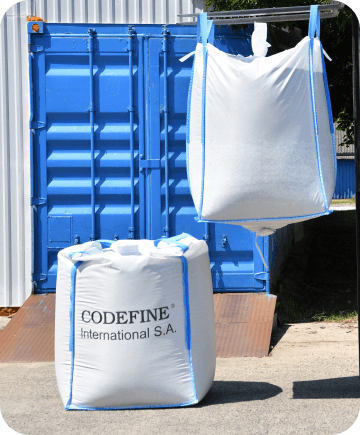
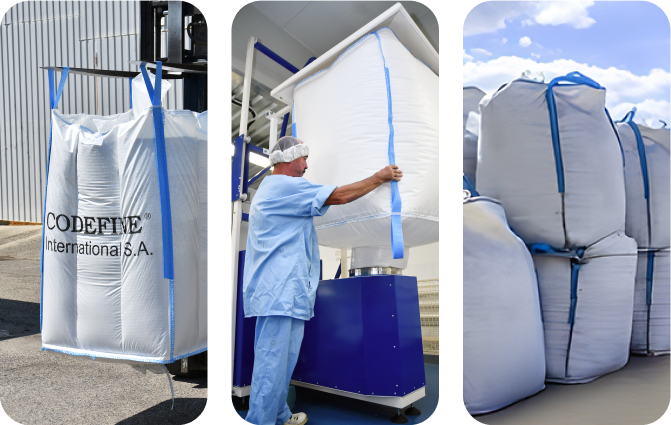
See how our products can improve your operations and drive your success.

Get in touch to find out how Codefine can support your business with tailored solutions and expert guidance.