
Home » Posts Page » Blog » Products and Materials » UN-Certified FIBCs vs. Standard Bulk Bags: Key Differences and Use Cases
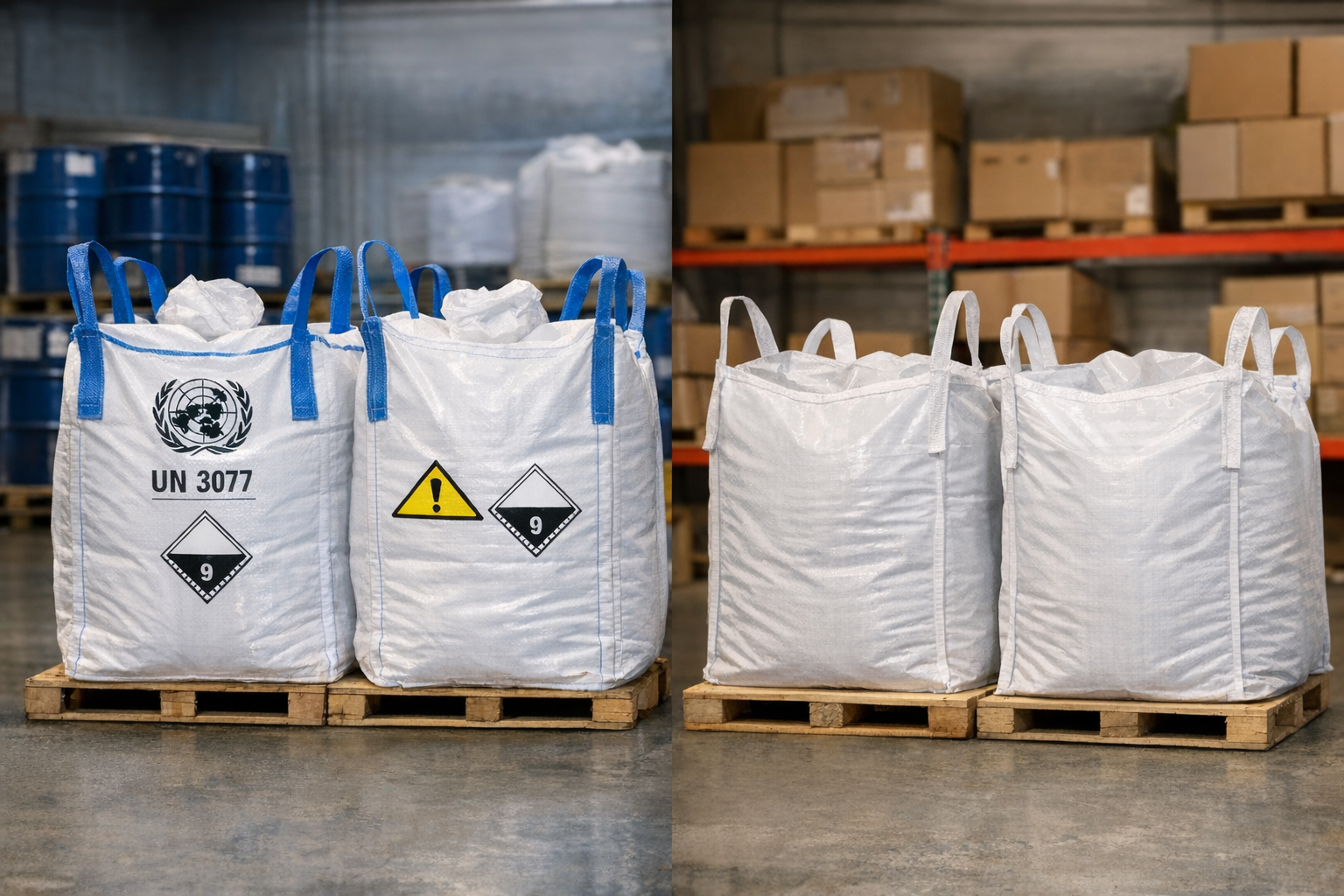
FIBCs, commonly known as bulk bags or super sacks, are large woven polypropylene containers designed to transport and store dry, flowable materials in quantities ranging from 500 to 4,000 pounds. While all FIBCs serve the basic function of bulk material containment, not all bags meet the same regulatory standards.
The certification landscape for FIBCs centers on the UN Recommendations on the Transport of Dangerous Goods, which establishes international standards for packaging hazardous materials. UN certification represents the highest standard of FIBC performance testing and quality assurance. When you see a UN marking on a bulk bag, it indicates that the packaging has undergone rigorous third-party testing and meets specific performance criteria for containing and transporting dangerous goods.
UN-certified FIBCs are bulk bags specifically designed, manufactured, and tested to meet stringent requirements outlined in UN dangerous goods regulations. These bags undergo comprehensive performance tests conducted by accredited third-party testing facilities.
The testing protocol includes drop tests that simulate impact forces during handling, top lift tests verifying that lifting loops can safely support six times the bag’s rated capacity, topple tests assessing integrity when tipped over, tear tests evaluating fabric strength, and stacking tests confirming bags can withstand compression forces during storage and transport.
Manufacturing requirements extend beyond the bags themselves. Producers must maintain detailed quality control systems, use specified materials and construction techniques, and implement rigorous documentation processes. Each production batch requires certification documentation that traces manufacturing details, test results, and compliance verification.
Standard FIBCs, while not UN-certified, are engineered to provide reliable performance for a wide range of industrial applications. These bags are manufactured with typical safety factors of 5:1 or 6:1, meaning they’re designed to hold five to six times their rated capacity without failure.
Standard FIBCs excel in applications where materials don’t fall under dangerous goods classifications. Agricultural products like grains and feed, food ingredients such as flour and sugar, construction materials including sand and cement, plastic pellets, and general manufacturing components all transport safely and economically in standard FIBCs. The bags provide excellent protection from contamination and moisture while offering significant cost advantages over rigid containers.
The distinctions between UN-certified and standard bulk bags extend across multiple dimensions. UN-certified FIBCs must pass the complete suite of performance tests mandated by UN regulations, conducted by independent accredited laboratories. Standard FIBCs, while typically tested by manufacturers, don’t undergo the same rigorous third-party testing protocols.
|
Feature |
UN-Certified FIBCs |
Standard Bulk Bags |
|
Third-Party Testing |
Required by accredited labs |
Manufacturer testing only |
|
Safety Factor |
Minimum 6:1 required |
Typically 5:1 or 6:1 |
|
Certification Documentation |
Detailed compliance paperwork |
Basic product specifications |
|
Typical Cost |
$15-$40 per bag |
$8-$25 per bag |
|
Primary Use |
Dangerous goods transport |
General industrial materials |
|
Regulatory Oversight |
DOT, IATA, IMDG compliance |
General safety standards |
UN-certified FIBCs typically cost 20-40% more than comparable standard bags due to additional testing requirements and manufacturing oversight. However, this cost difference becomes minimal when compared to potential regulatory fines or liability exposure.
Multiple regulatory frameworks govern dangerous goods transport and specify when UN-certified packaging is mandatory. In the United States, the Department of Transportation (DOT) enforces hazardous materials regulations under 49 CFR. For many materials classified as flammable liquids, flammable solids, oxidizers, toxic substances, corrosives, and miscellaneous dangerous goods transported in bulk quantities, UN-certified packaging is required.
International air transport follows the IATA Dangerous Goods Regulations, while maritime transport adheres to the IMDG Code. Both align with UN recommendations and mandate certified packaging for containerized dangerous goods.
The legal implications of non-compliance are severe. Regulatory fines can reach tens of thousands of dollars per violation. Companies face potential criminal liability if non-compliance results in injuries or environmental damage. Insurance coverage may be voided for incidents involving non-compliant packaging, exposing companies to unlimited liability.
UN-certified bulk bags serve critical roles in industries where material hazards demand the highest packaging performance standards. Chemical manufacturing facilities producing organic chemicals, industrial solvents, and specialty chemicals rely on certified packaging to safely transport products. Pharmaceutical ingredient manufacturing requires UN-certified packaging for many active pharmaceutical ingredients (APIs) that carry hazard classifications.
The mining and explosives industry depends entirely on UN-certified packaging for transporting blasting agents and explosive precursors. Hazardous waste management operations use certified FIBCs when consolidating contaminated materials for proper disposal. International shipping scenarios often require UN certification even for materials that might be transported domestically in standard packaging, as shipments must comply with varying national regulations across multiple transportation modes.
Standard FIBCs provide cost-effective solutions for the vast majority of industrial materials that don’t fall under dangerous goods classifications. Agricultural operations use standard bags for grains, seeds, and animal feed. Food ingredient manufacturers rely on food-grade standard FIBCs with appropriate liners for flour, sugar, and spices.
Construction operations benefit from standard bulk bags for sand, gravel, and dry concrete mix. Plastic manufacturing and recycling operations use standard FIBCs for virgin resin pellets and recycled plastic flake. Manufacturing operations across diverse industries use standard bags for components, raw materials, and work-in-process inventory where materials don’t require dangerous goods packaging.
Selecting between UN-certified and standard FIBCs requires a systematic evaluation of your operational requirements and regulatory obligations. Begin with material classification by consulting the Safety Data Sheet (SDS) for each material. If your material carries a UN number, UN-certified packaging is typically required for transport.
The transportation method significantly influences requirements. Materials transported on public roads, railways, waterways, or aircraft must comply with dangerous goods regulations when classified as hazardous. International shipments face the most stringent requirements, making UN certification the most reliable approach for ensuring consistent compliance.
Consider your risk tolerance and liability exposure. Even for materials where standard bags might be technically acceptable, the enhanced performance characteristics of UN-certified packaging provide valuable additional security for high-value materials or environmentally sensitive operations.
Codefine provides comprehensive FIBC solutions spanning both UN-certified and standard bulk bags. Our UN-certified FIBCs meet all performance testing requirements with third-party testing conducted by accredited laboratories and complete documentation packages that streamline compliance verification. Our standard FIBC line offers the same manufacturing quality without certification overhead, providing cost-effective solutions for non-hazardous materials.
Our consultative approach distinguishes us from typical suppliers. Our team includes professionals with deep knowledge of DOT, IATA, and IMDG regulations who help you accurately assess packaging requirements based on material classifications and transportation scenarios. We review Safety Data Sheets, evaluate logistics chains, and recommend appropriate packaging solutions that ensure compliance while optimizing costs.
When do I legally need a UN-certified FIBC?
You must use a UN-certified FIBC when transporting any material categorized as a dangerous good under the UN Recommendations, including chemicals, flammable powders, and hazardous waste.
Are UN-certified FIBCs more expensive than standard bulk bags?
Yes, due to rigorous testing requirements and stronger construction. However, they are essential for compliance and safety when transporting high-risk materials.
Can standard FIBCs be used for chemicals?
They can be used only for non-dangerous chemicals. Any hazardous chemical or regulated material requires a UN-certified FIBC.
Does Codefine supply both UN-rated and standard bulk bags?
Yes, Codefine provides fully compliant UN-certified FIBCs and versatile standard FIBC options tailored to various industries and load requirements.
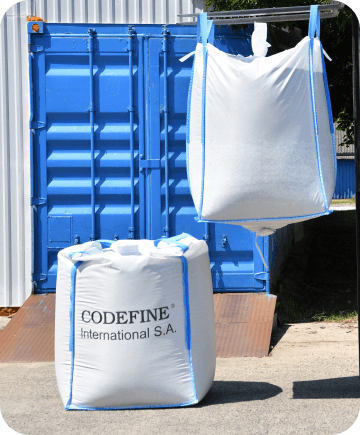
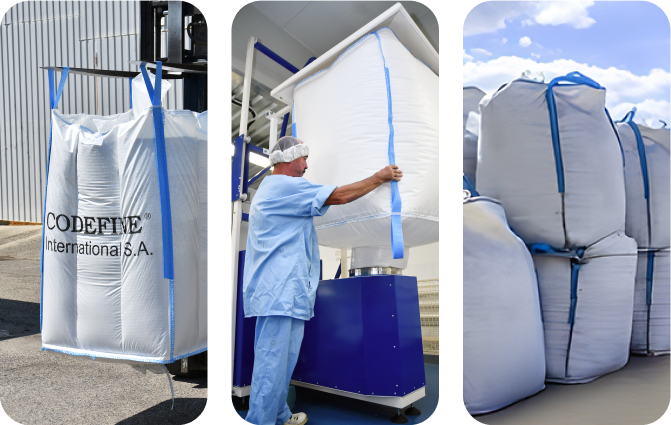
See how our products can improve your operations and drive your success.
Get in touch to find out how Codefine can support your business with tailored solutions and expert guidance.