
Home » Posts Page » Blog » Products and Materials » UN Markings for FIBC Bulk Bags Explained: Codes, Testing & Requirements
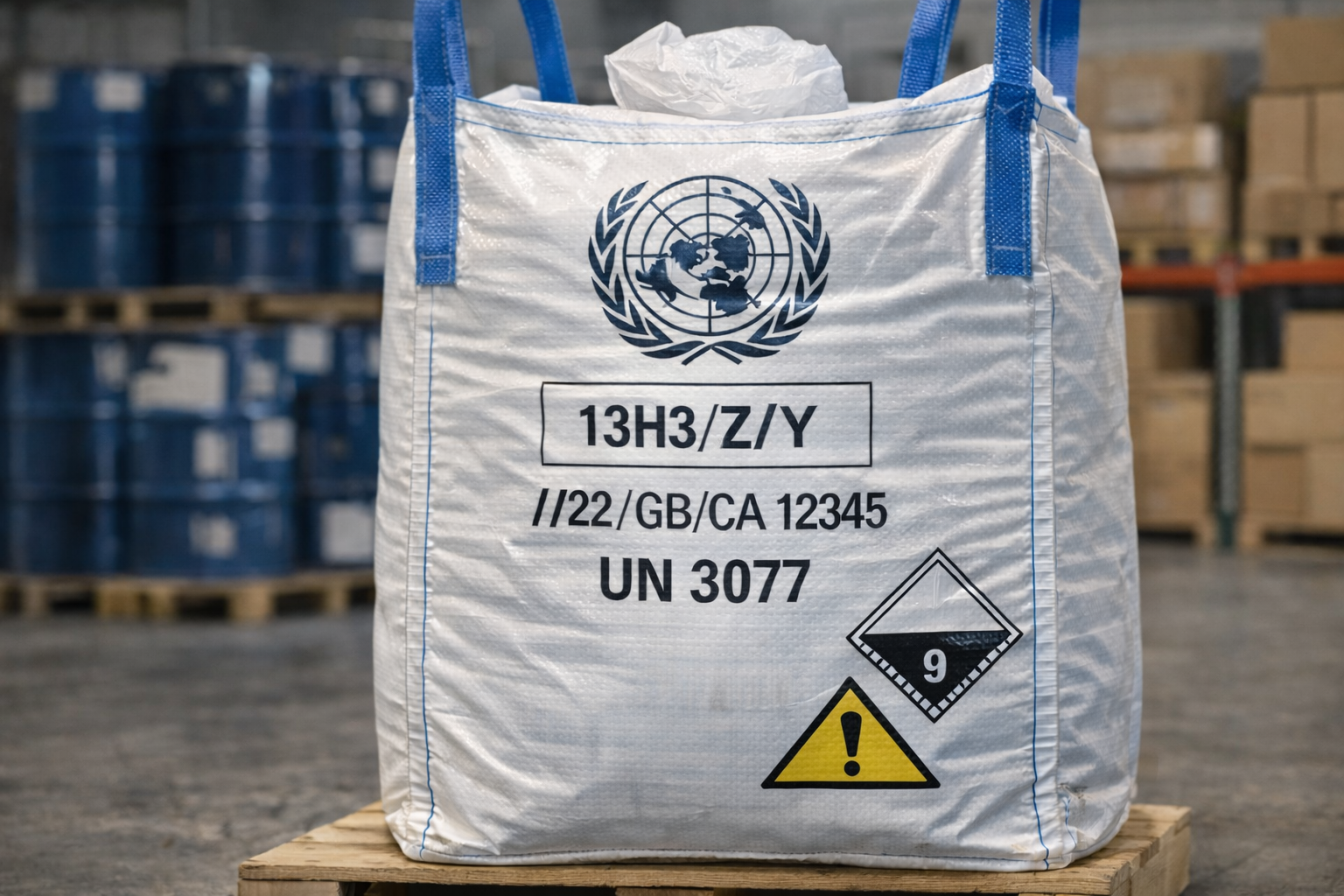
UN markings are standardized codes printed or sewn onto FIBCs that have been tested and certified for transporting dangerous goods. These markings verify that the packaging meets performance standards established by the UN Recommendations on the Transport of Dangerous Goods, a globally recognized regulatory framework that ensures hazardous materials can be transported safely across all modes of transportation.
The marking system creates a universal language for dangerous goods packaging. Whether an FIBC is manufactured in China, shipped through Europe, or used in North America, the UN marking provides instantly recognizable proof of certification that inspectors, handlers, and regulatory authorities worldwide can interpret. This standardization eliminates ambiguity and ensures consistent safety standards across international supply chains.
UN markings serve multiple critical functions in dangerous goods logistics. They provide immediate visual confirmation that packaging has undergone rigorous third-party testing, allowing inspectors and handlers to verify compliance at a glance without reviewing extensive documentation. The codes communicate essential technical specifications, including weight limits, performance levels, and appropriate use cases, enabling quick matching of packaging to material requirements.
For international shipments, UN markings eliminate confusion caused by varying national regulations. A properly marked FIBC certified in one country is recognized as compliant in virtually all jurisdictions that regulate dangerous goods transport. This universality streamlines customs clearance, simplifies carrier acceptance procedures, and reduces documentation requirements at border crossings.
A typical UN marking appears as a series of codes separated by slashes, such as: 13H3/Y/250/S/19/USA/ABC123. Each element conveys specific information about the packaging’s certification and capabilities. Understanding how to decode these markings is fundamental to ensuring proper packaging selection and regulatory compliance.
The first element identifies the packaging type and construction. The number “13” designates a flexible container (as opposed to drums, boxes, or other rigid packaging types). The letter “H” indicates woven plastic material without coating or liner, while “L” would indicate plastic film or coated material. The final digit specifies the category “3” represents a flexible container without structural equipment, while “4” would indicate a flexible container with structural equipment or liner.
The single letter following the packaging code indicates which packing groups the bag is certified to contain. Packing groups classify dangerous goods by their degree of danger: Group I represents high danger, Group II medium danger, and Group III low danger. An “X” marking certifies the bag for all three packing groups, “Y” certifies for Groups II and III, and “Z” certifies only for Group III. Most FIBCs carry “Y” ratings, as very few bulk materials fall into Packing Group I.
This number represents the maximum weight in kilograms that the packaging is certified to contain safely. A marking of “250” indicates certification for up to 250 kg (approximately 550 pounds). Common ratings for FIBCs range from 500 to 2000 kg, depending on bag size and construction. This rating must never be exceeded, as testing validates performance only up to the specified weight.
The letter “S” indicates the bag is tested for solid materials, while “L” would indicate liquid testing. This distinction matters because solids and liquids exert different stresses on packaging. Most FIBCs carry “S” designations, as bulk bags are primarily used for powders, granules, and other solid materials rather than liquids.
The two-digit year code indicates when the packaging was manufactured. “19” represents 2019, “24” would be 2024, and so forth. This date is critical because UN-marked packaging has practical use limitations. Most carriers and regulatory authorities restrict dangerous goods transport to packaging manufactured within the previous 12-24 months, as materials degrade over time and testing doesn’t account for aging effects.
The ISO country code identifies where the packaging was manufactured and certified. Following the country code, the manufacturer identification code traces the specific producer. This traceability is essential for quality control, recall procedures, and accountability if packaging failures occur. Regulatory authorities maintain registries of authorized manufacturer codes.
The ISO country code identifies where the packaging was manufactured and certified. Following the country code, the manufacturer identification code traces the specific producer. This traceability is essential for quality control, recall procedures, and accountability if packaging failures occur. Regulatory authorities maintain registries of authorized manufacturer codes.
Earning a UN marking requires FIBCs to pass a comprehensive battery of performance tests conducted by accredited third-party laboratories. Drop tests verify that fully loaded bags can withstand impacts from falls at specified heights onto hard surfaces, simulating real-world handling accidents. Top lift tests confirm that lifting loops support at least six times the bag’s rated capacity without failure, ensuring adequate safety margins during crane and forklift operations.
Test Type | Test Parameters | Performance Requirement | Purpose |
Drop Test | 0.8-1.8m height, depending on the packing group | No content loss | Impact resistance |
Top Lift Test | 6x maximum gross mass | No loop failure | Lifting safety verification |
Topple Test | Full rotation when loaded | No rupture or loss | Stability under stress |
Tear Test | Propagation of 100mm cut | Limited tear extension | Fabric strength validation |
Stacking Test | 1.8x load for 28 days | No deformation/failure | Storage capability |
Topple tests assess integrity when fully loaded bags tip over, while tear propagation tests evaluate how damage spreads through fabric. Stacking tests verify that bags can support compression loads when stored multiple units high. Only bags that pass all required tests receive UN markings with the appropriate certification codes.
When receiving UN-marked FIBCs, begin by locating the marking, typically printed on a label sewn to the bag or directly printed on the fabric. Verify all elements are present and legible; incomplete markings indicate non-compliant packaging. Check the manufacturing date to ensure the bag is within acceptable age limits for your carriers and materials.
Match the performance level to your material’s packing group classification found on the Safety Data Sheet. A material in Packing Group II requires bags marked “X” or “Y,” never “Z.” Verify the maximum gross mass rating exceeds your intended fill weight with an appropriate safety margin. Confirm the solid/liquid designation matches your material state.
Frequent compliance failures include using bags beyond their practical service life, even though markings remain legible. A bag manufactured three years ago may still show clear UN markings, but no longer meets carrier acceptance standards. Mismatching performance levels to packing groups, such as using a “Z” rated bag for a Packing Group II material, creates serious regulatory violations even if other specifications seem adequate.
Exceeding the maximum gross mass rating, even by small margins, invalidates the certification since testing only validates performance up to the specified weight. Using bags marked “S” for liquid or semi-liquid materials, or reusing single-trip certified bags for subsequent dangerous goods shipments, are violations that expose companies to significant fines and liability.
Codefine provides properly UN-marked FIBCs backed by legitimate third-party testing from accredited laboratories. Every bag we supply includes comprehensive certification documentation that matches the UN markings, simplifying your compliance verification and audit processes. Our packaging experts help you decode UN marking requirements and select bags with appropriate codes for your specific materials and transportation scenarios.
Q1: What does the UN marking on an FIBC tell you?
A: The UN marking provides critical certification information, including the packaging type, material construction, performance level, maximum weight capacity, whether it’s tested for solids or liquids, manufacturing date, country of origin, and manufacturer identification. This code verifies that the bag has passed the required performance tests for transporting dangerous goods.
Q2: How long is a UN marking valid on a bulk bag?
A: While UN markings don’t have a fixed expiration date, regulatory agencies and carriers typically limit the use of UN-marked packaging to 12-24 months from the manufacturing date for dangerous goods transport. The two-digit year code in the marking indicates when the bag was manufactured, allowing inspectors to determine age and appropriateness for use.
Q3: What’s the difference between 13H3 and 13H4 UN markings?
A: The difference is in the packaging category number. 13H3 indicates a standard woven plastic flexible container without a separate liner, while 13H4 indicates a woven plastic flexible container with a separate liner. The liner provides additional protection and containment, particularly for fine powders or materials requiring moisture barriers.
See how our products can improve your operations and drive your success.
Get in touch to find out how Codefine can support your business with tailored solutions and expert guidance.