
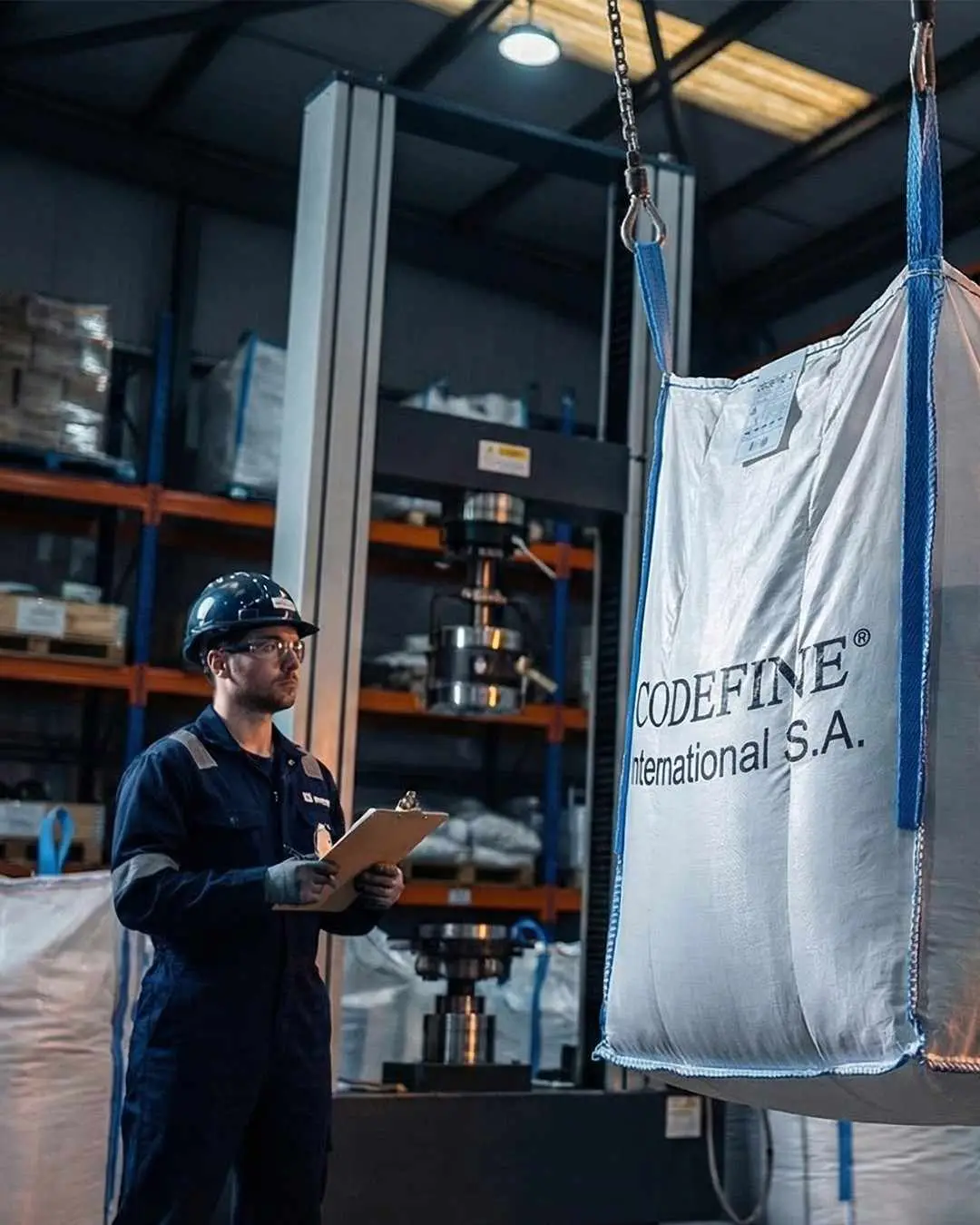
A bulk bag carrying a hazardous powder has to earn the right to do that job long before it reaches your filling line. Under the UN Recommendations on the Transport of Dangerous Goods, known as the Orange Book, every flexible intermediate bulk container (FIBC) used for dangerous goods must pass a demanding series of physical tests and win approval from a competent authority. Only then can it carry the UN mark that carriers, ports and inspectors look for.
An unapproved bag turns a routine consignment into a rejected load, a fine or a spill on the quayside. Understanding how design type testing works, what invalidates it, and how recertification keeps it current lets you question suppliers more sharply and catch weak paperwork early.
The sections below follow the rules behind a UN-certified FIBC, from the tests themselves to the mark printed on the bag.
The Orange Book is the common name for the UN Model Regulations, a set of recommendations drafted by the UN Committee of Experts on the Transport of Dangerous Goods and revised every two years. The latest edition, Rev. 24, appeared in 2025.
The Orange Book is not law in itself, but nearly every transport regulation is built on it. The IMDG Code for sea, ADR and RID for European road and rail, the ICAO rules for air, and national rules such as 49 CFR in the United States all base their packaging requirements on its text. A bag approved to the UN standard in one country is generally accepted across borders without a fresh round of testing.
FIBCs are covered in Chapter 6.5, which sets out how they must be built, gives each type a code (13H3, for example, is a woven plastic bag with a liner) and lists the tests a design must pass. Flexible IBCs only carry solids, so the leakproofness and hydrostatic pressure tests do not apply to them. Instead, mechanical tests modelled on real handling, from lifting and dropping to tipping and stacking, are performed.
If your product appears on the dangerous goods list and its packing instruction permits FIBCs, the bag you choose must come from an approved design type, whether you move chemicals or mineral concentrates.
Testing is carried out on filled bags, with the product or a substitute of similar particle size and density. Each test checks one way a full bag can fail, and a design must pass every test that applies to it before it can be approved.
Most FIBCs are moved by their loops, which makes the top lift test the most relevant. The bag is loaded to six times its maximum permissible gross mass and raised clear of the floor. It has to hang there for five minutes without damage that would make it unsafe and without losing any contents. That six-to-one ratio mirrors the safety factor many buyers know from standard FIBC bulk bags.
The righting test looks at a different moment. A full bag lying on its side is pulled upright by one lifting loop, or by two when it has four, at a speed of at least 0.1 metres per second. Anyone who has watched a forklift driver recover a tipped bag will recognise the scene, and the loops and seams must survive it intact.
Drops are routine in warehouses and on loading docks, so the drop test is mandatory for every flexible design type. The bag, filled to its maximum permissible gross mass, falls onto a rigid surface and lands on the most vulnerable part of its base. Drop height follows the packing group, from 1.8 m for Packing Group I down to 1.2 m for Packing Group II and 0.8 m for Packing Group III.
The topple test borrows those heights but changes the angle of impact. A bag filled to at least 95 percent of its capacity is tipped so it strikes the ground on any part of its top. In both tests, a slight discharge through closures or stitch holes is tolerated, provided no further leakage follows once the bag is lifted clear of the ground.
Woven polypropylene is tough until it is cut, and the tear test checks what happens next. The tester fills the bag and slices a 100 mm cut through one wide face at a 45-degree angle, halfway between the base and the top of the contents. A uniform load of twice the maximum permissible gross mass then rests on top for at least five minutes, and bags designed to be lifted from the top or side are hoisted clear of the floor for another five minutes. The cut may not grow by more than a quarter of its original length.
Stacking applies only to designs intended to be stacked. The test load equals 1.8 times the combined maximum gross mass of the bags that could sit on top during transport, held for at least 24 hours. Bags not designed for stacking show a zero in that part of their UN mark.
Approval belongs to a design type, not to the supplier, so you need to know what counts as one. The Orange Book defines a design type by its design, size, material and thickness, how it is made, and how it is filled and emptied. If any of these change, the regulator may see a different bag, even if it looks the same on the pallet.
Some changes are allowed. A bag with a different surface treatment, or a smaller bag made from the same materials, still counts as the same design type. The competent authority can also allow partial testing when a design changes only slightly, so manufacturers don’t have to repeat every test for each small tweak.
Problems usually come from changes that look small in the factory but affect how the bag performs. A lighter fabric, new loops, different stitching, or a new coating or liner can each change the result of a test. So if a supplier offers you an improved bag, ask whether that exact bag was tested and whether there is a report to prove it. If you can’t get a clear answer, the approval may not cover the bag you are about to fill.
Passing the tests doesn’t mean the job is done. The Orange Book requires every IBC to be manufactured and tested under an approved quality assurance programme, and it gives authorities the right to demand proof at any time that production bags still meet the design type requirements. ISO 16106 is the standard most often used to structure such a programme.
Unlike metal, rigid plastic and composite IBCs, flexible bags are not subject to the periodic inspections and leakproofness tests written for reusable units. Recertification for FIBCs works through periodic retesting of the design type instead, with the interval set by national rules and the approving authority rather than by the Orange Book itself. In the United States, 49 CFR requires design requalification at least once every 12 months, and approval certificates issued elsewhere usually carry their own retest conditions.
Every round of testing leaves a paper trail. The test report has to identify the test facility, the manufacturer, the design type with its materials and dimensions, the test contents and the results, and it must be made available to users of the bag. A supplier who hesitates to share that report, or whose certificate is several years old with no sign of retesting, deserves a closer look before your next order goes out.
The UN mark is the fastest check you have, and it packs a surprising amount into two short lines. Characters must be at least 12 mm high. The elements always appear in the same order, starting with the UN packaging symbol and the IBC type code, followed by a letter for the packing groups covered, the month and year of manufacture, the authorising country and the manufacturer, and ending with the stacking test load and the maximum permissible gross mass in kilograms.
A mark reading 13H3/Z/0301 with F/Meunier 1713/0/1500 beneath it describes a woven plastic bag with a liner, approved for Packing Group III, made in March 2001 and authorised in France, not designed for stacking and rated to 1,500 kg gross. Pay close attention to that packing group letter. X covers groups I to III and Y covers II and III, while Z is limited to group III, so a Z-marked bag cannot carry a Packing Group II substance no matter how sturdy it looks.
Matching the mark against your consignment, the certificate, and the test report closes most of the gaps that lead to rejected loads. Codefine supplies UN-certified bags for hazardous chemicals, agricultural inputs, and waste and recycling streams, and can provide the documentation that backs each design type.
Yes, the UN-certified FIBCs require retesting. The design type has to be requalified at intervals set by national rules and the competent authority. In the United States, that means at least once every 12 months, while elsewhere the approval certificate and the manufacturer’s quality assurance programme set the schedule. Authorities can also demand fresh proof of compliance at any time.
Drop, topple and tear tests apply to every flexible design type. Top lift and righting tests cover bags designed to be lifted from the top or side, which includes nearly all FIBCs, and the stacking test applies only to designs meant for stacking. Leakproofness and hydrostatic tests are skipped because flexible bags carry solids only.
The 6:1 safety factor comes from ISO 21898 and applies to bulk bags for non-dangerous goods. The UN top lift test is a pass-or-fail check for dangerous goods approval, where the bag must hold six times its maximum permissible gross mass for five minutes. A bag carrying dangerous goods needs UN approval, whatever its ISO rating.
Changing the liner can affect UN approval. Liner material and construction form part of the design type for lined codes such as 13H3. Swapping to a liner of different material or thickness may create a new design type that needs its own testing, so confirm the exact combination appears in the test report before you switch.
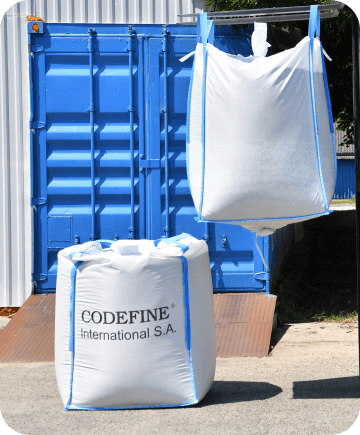
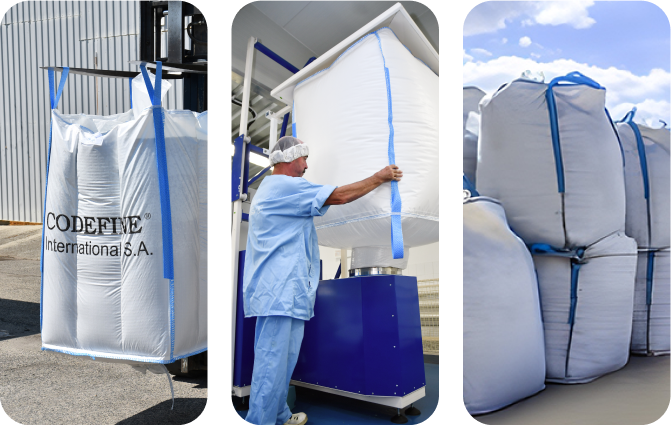
See how our products can improve your operations and drive your success.
Get in touch to find out how Codefine can support your business with tailored solutions and expert guidance.