
Home » Posts Page » Blog » Industry-Specific Solutions » FIBC Requirements for Hygroscopic Materials in Chemical Manufacturing
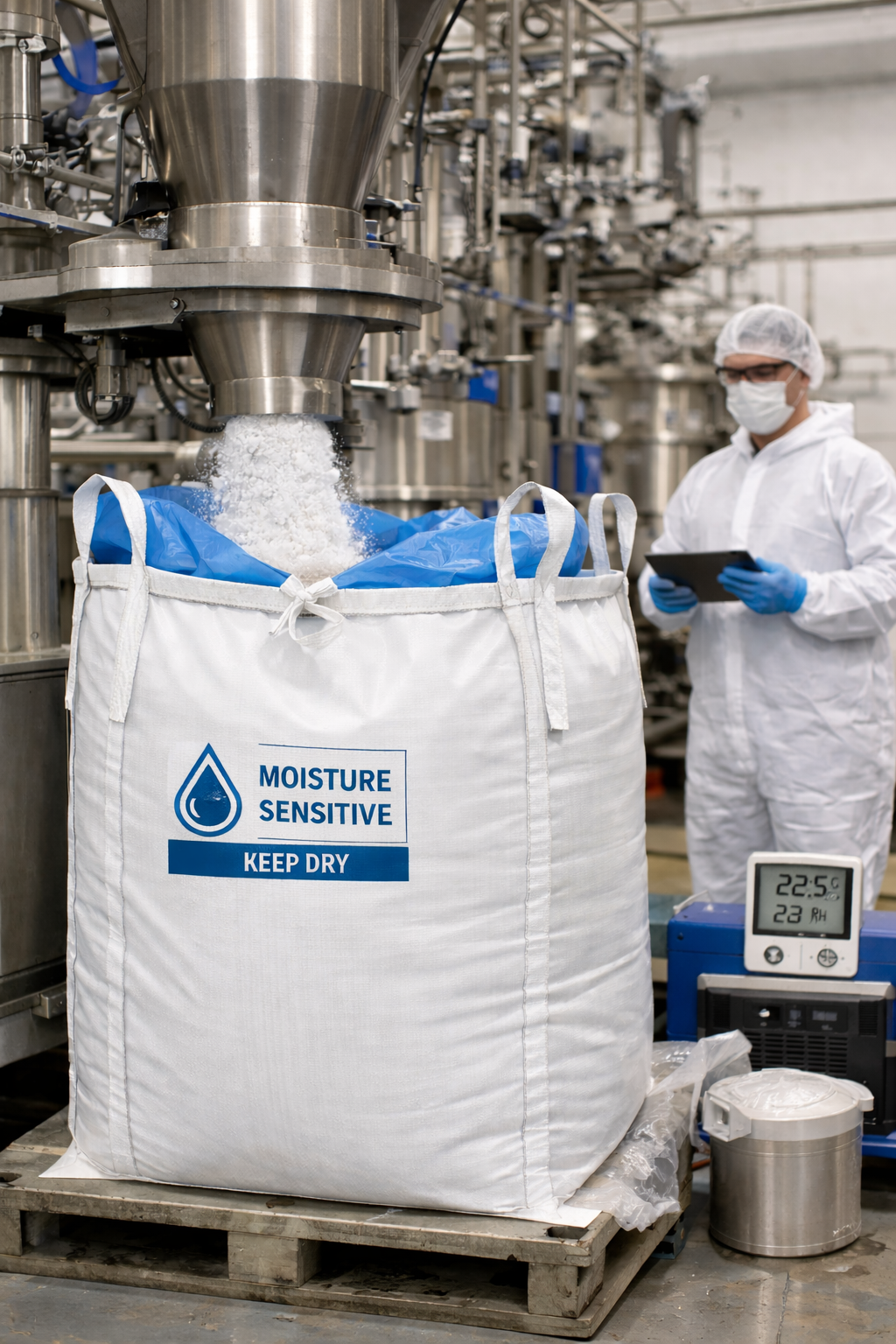
Hygroscopic materials naturally absorb water vapor from the air. In chemical manufacturing environments, even small fluctuations in humidity during filling, storage, or transportation can cause measurable changes in product performance.
Common examples include:
When exposed to moisture, these materials may clump, cake, lose flow properties, or undergo chemical alteration. In high-throughput facilities, compromised material flow can slow production lines, damage equipment, and increase waste.
For these applications, FIBCs must be engineered specifically for moisture resistance, not simply selected based on load capacity alone.
Moisture exposure can occur at multiple points in the supply chain.
Production Environment Risks
During filling operations, ambient humidity can infiltrate bulk bags if liner systems are not properly sealed. Open spout designs and loosely fitted liners increase exposure. Condensation may also form when temperature differences exist between stored materials and the production floor environment.
In facilities that operate continuously, repeated exposure to fluctuating humidity conditions can degrade product quality over time.
Moisture Sensitivity vs. Recommended FIBC Configuration
Moisture Sensitivity | Recommended Liner | Fabric Requirement | Additional Protection |
Low | Standard PE liner | Coated woven PP | Basic seam sealing |
Moderate | Multi-layer PE liner | Laminated woven PP | Dust-tight seams |
High | High-barrier or co-extruded liner | Fully laminated FIBC | Heat-sealed liner |
Very High | Aluminum barrier liner | Laminated + reinforced FIBC | Container liner (export) + static protection if required |
Transportation and Export Risks
Sea freight presents one of the highest moisture risks. Temperature changes inside containers can create condensationб commonly referred to as “container rain.” Without proper liner systems, hygroscopic materials can absorb this moisture during transit.
For export-driven chemical manufacturers, integrating FIBCs with moisture-resistant inner liners or combining packaging with container liners provides an added layer of environmental control throughout transport.
Selecting the correct FIBC configuration is critical. Several technical factors directly influence moisture protection performance.
The liner system is the primary defense against humidity. Polyethylene (PE) liners are commonly used to create a barrier between the woven polypropylene outer fabric and the chemical product. For higher-sensitivity materials, multi-layer or co-extruded liners offer improved vapor resistance.In particularly demanding applications, aluminum barrier liners may be required to provide maximum protection against moisture transmission. Codefine engineers FIBCs with integrated liner systems designed specifically for moisture-sensitive chemical applications. Heat-sealed liners can further reduce air ingress, while form-fit liners improve consistency and reduce liner shifting during filling.
The outer fabric of an FIBC also plays an important role. Uncoated woven polypropylene fabrics allow greater air permeability, which may be suitable for non-sensitive materials but is generally insufficient for hygroscopic chemicals. Coated or laminated woven PP fabrics improve moisture resistance and reduce vapor transmission. In anti-humidity FIBC bulk bag designs, coating enhances structural integrity while supporting liner performance. Codefine provides coated and laminated FIBCs tailored to chemical manufacturing environments where humidity control is essential.
Even the most advanced liner can fail if seam construction allows moisture ingress. Dust-tight stitching and reinforced seam sealing reduce the risk of leakage and humidity exposure.
In chemical facilities handling fine powders, preventing sifting and maintaining containment is equally important for both product quality and workplace safety.
Proper seam engineering ensures the FIBC performs as a complete moisture-control system rather than as a simple load-bearing container.
Discharge systems must minimize exposure during unloading. Wide-open discharge designs increase the time material is exposed to ambient air. Controlled discharge spouts and protective closures help limit air contact during emptying.
When automated discharge systems are used, FIBC geometry and spout configuration must align with the equipment to avoid delays that prolong environmental exposure.
Many hygroscopic chemical powders also generate static electricity during filling and discharge. In facilities where fine powders are present, electrostatic discharge may pose safety risks.
Depending on environmental conditions and material characteristics, Type C (conductive) or Type D (static dissipative) FIBCs may be required. Selecting the appropriate static-protection category is essential for maintaining safe chemical manufacturing operations.
Codefine offers static-protective FIBCs engineered for chemical applications where moisture sensitivity and electrostatic control must be addressed simultaneously.
Moisture-related failures often stem from incorrect packaging selection rather than material defects. One common mistake is using standard, unlined FIBCs for moisture-sensitive chemicals. Without a proper vapor barrier, product degradation is almost inevitable. Another frequent issue is poorly fitted liners that shift during filling, creating gaps that allow humidity infiltration. Manufacturers sometimes underestimate export-related humidity exposure, assuming domestic storage conditions apply during sea freight. In reality, container environments can vary dramatically. Finally, failure to evaluate seam sealing, discharge design, and liner integration as a complete system can undermine otherwise well-specified packaging.
Choosing the appropriate bulk packaging solution requires evaluating several variables:
For moderate moisture sensitivity and short storage periods, coated FIBCs with integrated PE liners may provide sufficient protection. For highly hygroscopic materials or long-distance export shipments, enhanced barrier liners combined with container liners for shipment protection may be necessary.
Codefine works with chemical manufacturers to assess these variables and engineer FIBCs that align with real production conditions and environmental risks.
Choosing the appropriate bulk packaging solution requires evaluating several variables:
For moderate moisture sensitivity and short storage periods, coated FIBCs with integrated PE liners may provide sufficient protection. For highly hygroscopic materials or long-distance export shipments, enhanced barrier liners combined with container liners for shipment protection may be necessary.
Codefine works with chemical manufacturers to assess these variables and engineer FIBCs that align with real production conditions and environmental risks.
See how our products can improve your operations and drive your success.
Get in touch to find out how Codefine can support your business with tailored solutions and expert guidance.