
Home » Posts Page » Blog » FIBC Considerations for Fertilizer and Agrochemical Packaging
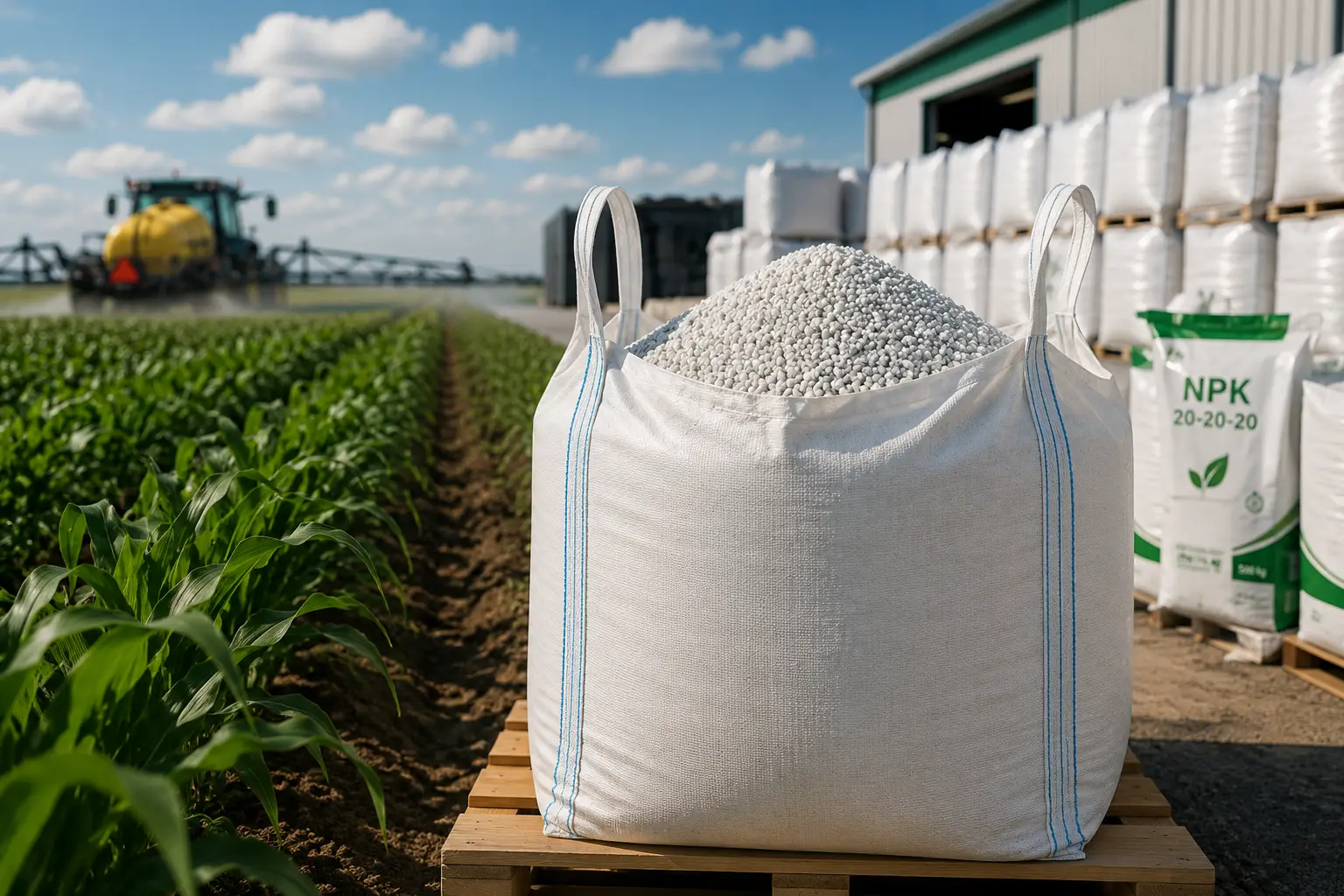
Fertilizer is one of the highest-volume product categories that moves through FIBCs in the US market, and it’s also one of the most punishing on packaging. The materials are hygroscopic, abrasive, dusty, and in some formulations classified as hazardous. A bag that works fine for sand or resin pellets can fail within weeks when packed with urea or ammonium nitrate.
The gap between “this FIBC holds 2,000 pounds” and “this FIBC keeps 2,000 pounds of potassium chloride dry and flowable through six months of warehouse storage” is where most fertilizer packaging problems live. Moisture intrusion, caking, static hazards, and regulatory mismatches all stem from choosing a bag on capacity alone without matching the construction to what the product actually does to the packaging over time.
This article walks through the FIBC specifications that matter for fertilizer and agrochemical applications: moisture management, static classification, UN certification where it applies, discharge design, and storage considerations. If your operation handles multiple fertilizer types across seasonal cycles, the spec decisions covered here affect everything from product quality at the point of application to your exposure on rejected loads and compliance audits.
Most dry fertilizers are hygroscopic to some degree, meaning they pull moisture out of the surrounding air. The rate varies dramatically by product. Urea is aggressive; it absorbs moisture at relative humidity levels above 70% and can start caking within days if the packaging doesn’t provide an effective barrier. Ammonium nitrate is similarly hygroscopic and adds an oxidizer classification on top of the moisture problem. Potash (potassium chloride) and muriate of potash are moderately hygroscopic but also abrasive and corrosive to metals, which matters for any hardware on the bag like grommets or wire ties.
NPK blends create their own challenge because you’re combining materials with different moisture behaviors in a single bag. The blend’s overall hygroscopic threshold depends on the most moisture-sensitive component in the mix. A 15-15-15 blend that includes urea will behave like urea from a packaging standpoint, even though the potash and phosphate components would tolerate more humidity on their own.
Dust generation during filling and discharge is another variable. Fine fertilizer particles can become airborne, creating respiratory hazards for workers and housekeeping problems in the filling area. Some fertilizer dusts are also combustible, which brings static discharge into the picture. Understanding why moisture damage happens at the packaging level is the starting point for specifying the right FIBC for any fertilizer product.
Two approaches dominate moisture protection in FIBC construction for fertilizer: coated outer fabric and PE inner liners. They work differently, and the choice affects bag performance, reusability, breathability, and cost.
Coated bags apply a polypropylene laminate to the woven fabric itself, creating a moisture barrier in the bag wall. The coating reduces breathability, which can trap condensation inside the bag during temperature swings. If a coated bag sits in a warehouse where daytime temperatures rise and nighttime temperatures drop, moisture can condense on the inner surface of the coated fabric and drip back onto the product. That’s the exact problem the coating was supposed to prevent.
A polyethylene (PE) liner takes a different approach. The liner sits inside an uncoated outer bag, creating a separate moisture barrier that can be sealed around the product. The uncoated outer fabric remains breathable, which allows any condensation between the liner and the bag wall to dissipate rather than pool. For fertilizers that will spend weeks or months in storage before application season, the liner approach handles temperature cycling better because moisture has an escape path through the outer fabric while the product stays sealed inside the PE film.
Liner thickness matters for fertilizer applications. Standard 80-micron PE works for short-term transit of less hygroscopic products. For urea, ammonium sulfate, and NPK blends that will sit in storage, stepping up to 100-micron or heavier PE gives you a more durable moisture barrier that’s less likely to develop pinholes from the product’s own abrasive surface pressing against it. The tips for keeping sensitive products dry in FIBCs apply here with particular urgency because a caked load of fertilizer isn’t just a quality issue; it’s an entire bag that may need to be broken up by hand or scrapped.
Fertilizer dust during filling and discharge can create electrostatic charge buildup on the bag surface. For most dry fertilizers, a Type A FIBC (standard woven polypropylene with no static protection features) is acceptable because the dust cloud concentration and ignition sensitivity don’t reach the thresholds that require higher classification.
The exception is any product or environment where flammable dust or vapor is present. If you’re filling sulfur-coated fertilizer in a facility that also handles flammable solvents, or if the fertilizer itself generates a dust cloud with a minimum ignition energy below the threshold for Type A bags, you need to step up to Type B at minimum. Type C (grounded conductive bags) or Type D (static-dissipative without grounding) apply in environments where the ignition risk is well documented.
Codefine’s guide on Type C vs. Type D static protection covers the selection criteria in detail. For fertilizer operations, the practical question is usually whether your filling environment introduces a flammable atmosphere. The product itself is the secondary variable. Ammonium nitrate, for instance, is an oxidizer, not a fuel, so its static classification depends more on what else is in the air during handling than on the product’s own properties.
Not all fertilizers require UN-certified packaging, but the ones that do carry serious compliance consequences if you get it wrong. Ammonium nitrate fertilizers above certain concentrations are classified as Class 5.1 oxidizers under DOT 49 CFR and the UN Recommendations on the Transport of Dangerous Goods. That classification triggers a requirement for UN-certified bulk bags that have passed the testing protocol for the relevant packing group.
Packing group determines the construction standard. Packing Group III (PG III, minor danger) is the most common classification for ammonium nitrate fertilizers, and it maps to a Y-rated FIBC under the UN marking codes system. PG II (medium danger) requires a Y-rated or X-rated bag depending on the specific substance. The markings on the bag (the 13H construction type codes, the Y or Z rating, the maximum gross mass, and the testing laboratory’s identifier) all need to match the product being shipped, and you can verify compliance by reading the FIBC label before filling.
Standard NPK fertilizers, potash, and most phosphate products don’t fall under hazardous goods classification and can ship in non-UN FIBCs. But if your product line includes any ammonium nitrate formulations, you need UN-certified bags in your inventory for those SKUs, and you need a system for making sure the right bag goes on the right filling line. Mixing a non-UN bag into a regulated product run creates a compliance violation that can result in fines, shipment holds, and customer rejections.
How the bag empties matters as much as how it fills. Fertilizer end users unload bags into spreaders, hoppers, blending equipment, and storage bins. Each destination works best with a specific discharge configuration.
Spout-bottom bags are the most common for fertilizer. The spout gives the operator controlled discharge into a receiving hopper or spreader inlet without opening the entire bottom of the bag. You can regulate the flow rate by opening the spout partially, and you can retie the spout if you need to interrupt discharge and resume later. For understanding FIBC discharge options, spout bottoms offer the best balance of control and speed for most fertilizer products.
Full-open (also called full-drop or diaper) bottoms dump the entire load at once. This works for high-volume hopper filling where speed matters and the receiving equipment can handle a rapid dump of 1,000 to 2,000 kg. It doesn’t work well for field spreaders or any application where you need metered discharge.
The right FIBC top design matters too. Duffle tops (a fabric flap that ties closed after filling) are common for fertilizer because they allow wide filling access for fast loading while sealing well enough to keep moisture and dust out during transit and storage. Spout tops give tighter closure but slow down the filling step if the product is coarse and doesn’t flow easily through a narrow opening.
Fertilizer follows agricultural cycles, which means bags packed in winter or early spring may sit in warehouses for months before they move to distributors and end users. That storage window exposes the packaging to stresses that short-haul transit bags never face.
UV degradation is the first risk. Polypropylene loses tensile strength under UV exposure, and even indoor storage in facilities with translucent roof panels or open dock doors exposes the top layers of stacked bags to enough light to start the process. UV-stabilized fabric extends shelf life, but it doesn’t eliminate the risk entirely. If bags are stored outdoors or in partially enclosed structures, the proper FIBC storage and handling practices for UV protection become non-negotiable.
Stacking compression is the second risk. Fertilizer is dense. A pallet of filled bags stacked three high puts significant load on the bottom tier, and over weeks or months that sustained compression can deform the bags, stress the seams, and compact the product inside. If you’re stacking bulk bags safely, the stacking limits for fertilizer should be conservative compared to lighter products. Baffle bags hold their shape under compression better than standard tubular construction and improve storage and transport efficiency when bags need to stack for extended periods.
Temperature cycling drives condensation, and condensation drives caking. This circles back to the liner discussion. A bag with a properly sealed PE liner and breathable outer fabric handles the daily temperature swing of a metal-roofed warehouse better than a coated bag that traps moisture against the product. For operations that plan their packaging purchases alongside seasonal demand planning, building the storage timeline into the bag spec is as important as getting the capacity right.
Start with the product, not the bag. Identify the hygroscopic threshold of your specific fertilizer formulation. Check whether it falls under any hazardous goods classification. Determine what discharge equipment your customers use and how long the product will sit in storage before it reaches the end user.
Match those answers to the bag construction. An uncoated FIBC with a sealed PE liner handles most dry fertilizer applications well. Step up to a heavier liner for highly hygroscopic products or long storage windows. Add UN certification for any regulated formulation. Choose a discharge style that matches your customers’ receiving equipment. Select a top design that balances filling speed with moisture protection.
Codefine’s FIBC buying checklist gives you a structured way to walk through these decisions. For fertilizer specifically, the product’s moisture behavior and the storage timeline should drive the spec. Everything else follows from those two variables. And if you handle multiple fertilizer types, you likely need multiple bag specs rather than a single compromise configuration that doesn’t serve any product particularly well.
Codefine manufactures FIBCs with an uncoated woven polypropylene outer and a sealed PE liner inside, which is the configuration best suited to fertilizer products that will sit in storage through seasonal cycles. The breathable outer fabric lets condensation escape during temperature swings while the PE liner keeps the product sealed and protected from moisture ingress.
Codefine supplies bags in both standard and UN-certified configurations for operations that handle regulated materials like ammonium nitrate alongside conventional fertilizer blends, so you can run multiple product lines from a single supplier with the right certification on each bag. Browse Codefine’s agricultural packaging solutions or get in touch to spec bags matched to your specific fertilizer formulations and storage timelines.
No. Only fertilizers classified as hazardous materials under DOT 49 CFR or the UN Recommendations on the Transport of Dangerous Goods require UN-certified bags. Ammonium nitrate fertilizers above certain concentrations are the most common example, classified as Class 5.1 oxidizers. Standard NPK blends, potash, and most phosphate products can ship in non-UN FIBCs.
A PE liner inside an uncoated bag generally handles fertilizer better than a coated bag for long-term storage. The uncoated outer fabric remains breathable, allowing condensation between the liner and the bag wall to dissipate during temperature cycles. A coated bag traps moisture on its inner surface, which can drip back onto the product and cause caking. For short-haul transit with minimal storage time, coated bags work, but most fertilizer applications benefit from the liner approach.
Type A (standard woven PP with no static protection) is acceptable for most dry fertilizer applications. Step up to Type B or higher if the filling environment contains flammable dust or vapor, if the fertilizer generates a combustible dust cloud during handling, or if the minimum ignition energy of the dust is below the threshold for Type A. Sulfur-coated fertilizers and facilities with mixed chemical handling are the most common scenarios where higher static classification applies.
Keep bags in a cool, dry, covered facility with good ventilation. Avoid direct UV exposure, even from translucent roof panels. Limit stacking height to account for the sustained compression load over time. Use baffle bags if you need tighter stacking. Ensure the PE liner is sealed to prevent moisture migration during temperature cycling. Inspect bottom-tier bags periodically for seam stress and deformation from compression.
Spout-bottom discharge is the most common and most versatile for fertilizer. It gives controlled, metereable flow into spreaders, hoppers, and blending equipment. Full-open bottoms work for high-speed hopper filling but can’t be paused mid-discharge. Match the discharge design to what your customers’ receiving equipment expects, and choose a spout diameter that suits the product’s flow characteristics (coarser products need wider spouts to prevent bridging).
See how our products can improve your operations and drive your success.
Get in touch to find out how Codefine can support your business with tailored solutions and expert guidance.