
Home » Posts Page » Blog » Codefine » Container Liner Compatibility: 20-Foot vs. 40-Foot vs. Reefer Container
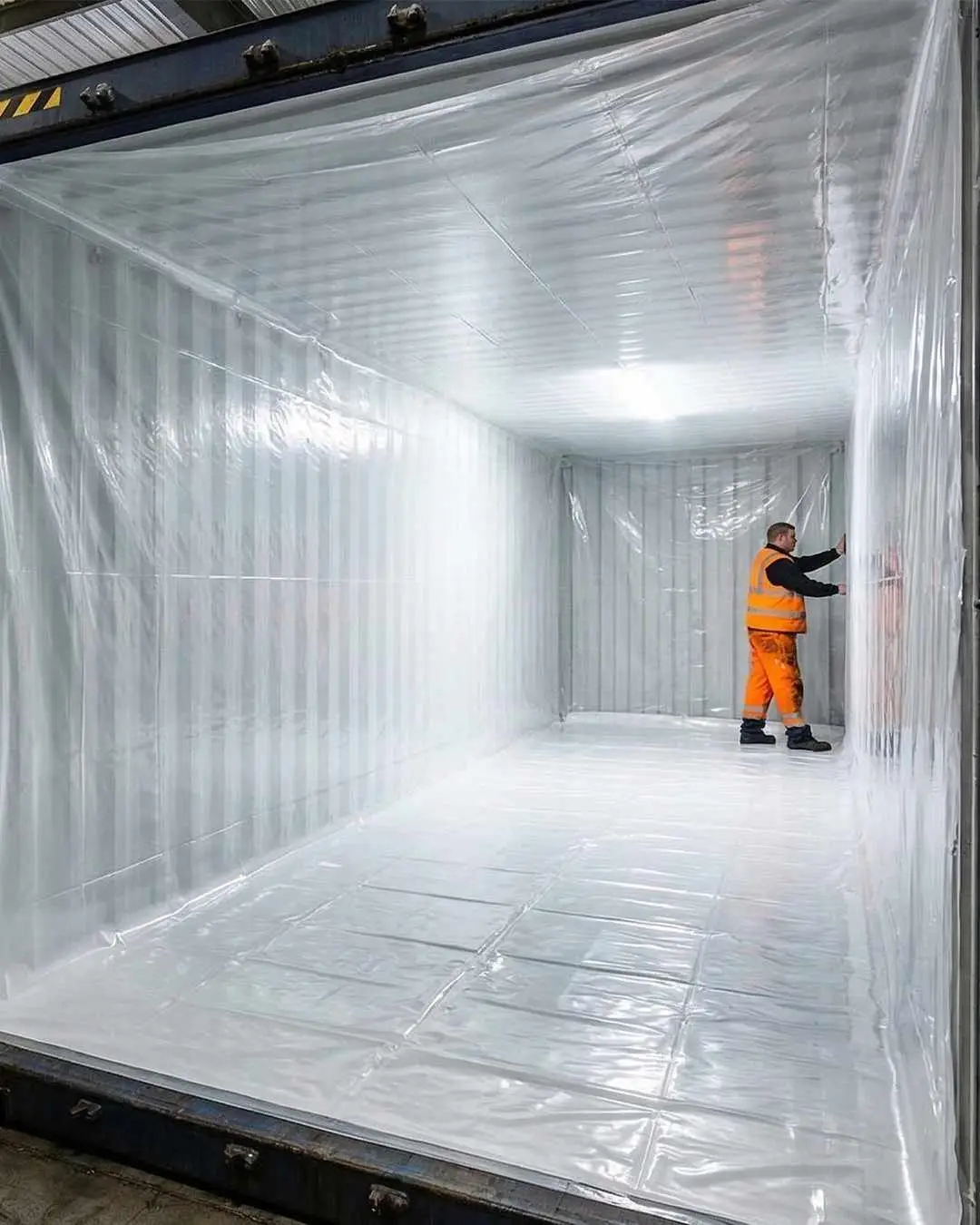
Choosing a container liner is not only about selecting the right material for the product being shipped. The container itself matters just as much. A liner designed for a 20-foot dry container cannot simply be transferred to a 40-foot unit, and compatibility becomes even more complex when refrigerated, or reefer, containers enter the equation.
For shippers moving dry bulk materials, understanding these differences helps prevent installation problems, inefficient loading, liner movement, and potential cargo contamination. The right approach starts with matching the liner design to the exact container type and shipping application.
A container liner converts the interior of a shipping container into a protected space for transporting dry, free-flowing bulk products such as grains, powders, minerals, chemicals, and other industrial materials. Codefine offers container liner solutions for container sizes ranging from 20 to 53 feet, with configurations adapted to different loading and unloading requirements.
However, liners are not universal bags that simply expand to fill whatever space is available. Length, internal height, door opening, anchor locations, discharge configuration, and container geometry all affect how the liner must be manufactured and installed.
Even containers with the same nominal size can vary slightly between manufacturers. Hapag-Lloyd, for example, specifically notes that its published container dimensions are representative and that individual equipment can differ.
That makes verifying the actual container specification an important part of liner selection.
A standard 20-foot dry container typically provides about half the internal volume of a 40-foot container. One Hapag-Lloyd 20-foot specification, for example, lists approximately 33.2 m³ of internal capacity, with an internal length of around 5.9 meters.
For liner applications, the smaller footprint can be particularly useful for dense products where maximum cargo weight may be reached before the available cubic capacity is fully used.
This can include products such as:
The shorter container length can also simplify liner installation and help maintain control of the liner during filling.
A properly engineered 20-foot liner must still match the container’s anchoring points, door area, filling method, and discharge system. Using an oversized liner designed for a longer container can create folds and excess material that interfere with loading or unloading.
A standard 40-foot dry container offers considerably more cubic capacity. Hapag-Lloyd lists approximately 67.7 m³ for one of its standard 40-foot container configurations, with an internal length slightly above 12 meters.
This makes 40-foot liners useful when cargo volume rather than weight is the primary limiting factor.
Potential applications include lower-density bulk materials that need additional space to reach an economical shipment quantity. A larger container can also help consolidate cargo that might otherwise require multiple smaller units.
However, doubling container length does not mean that liner design is simply doubled as well.
A 40-foot liner has a larger unsupported surface area and requires the anchoring, tensioning, filling, and discharge system to manage the material correctly throughout loading and transport. Installation therefore needs to follow the liner manufacturer’s specifications carefully.
Codefine’s Bulksaver® system, for example, is available for both 20-foot and 40-foot containers and uses a patented barless design that eliminates the conventional metal-bar support system.
|
Factor |
20-Foot Dry Container |
40-Foot Dry Container |
|
Internal volume |
Lower |
Approximately twice as much |
|
Best suited to |
Smaller loads and dense products |
Larger-volume and lower-density loads |
|
Liner length |
Shorter |
Longer |
|
Installation |
Smaller area to position and secure |
Requires control across a larger internal area |
|
Main selection concern |
Cargo density and payload |
Cargo volume, liner support and filling method |
The best option is ultimately determined by more than container size. Cargo bulk density, required payload, loading equipment, discharge system, route, and handling environment should all be considered before specifying the liner.
This is where compatibility needs much closer attention.
A reefer container is not simply a dry container with refrigeration added. Its internal construction includes refrigeration equipment, insulated walls, defined load limits, and a T-floor designed to maintain controlled airflow around the cargo.
For comparison, one Hapag-Lloyd 20-foot reefer has an internal length of approximately 5.45 meters and capacity of 28.1 m³, compared with approximately 5.9 meters and 33.2 m³ for its cited standard 20-foot dry container.
The airflow system creates an even more important difference.
Reefer operators require cargo to be positioned so that air can circulate correctly through and around the load. Hapag-Lloyd advises against obstructing airflow, loading beyond the T-floor, or exceeding the container’s designated load line. It also warns that plastic wrapping can act as a vapor barrier and interfere with air circulation.
For that reason, a conventional dry-bulk container liner should not automatically be considered compatible with an operating reefer container.
In fact, Hapag-Lloyd lists bulk commodities such as grain among cargo types prohibited in its non-operated reefer program, illustrating why reefer use must be evaluated separately from ordinary dry-container loading.
If a shipment requires both bulk containment and refrigerated equipment, the liner, cargo, airflow requirements, refrigeration system, and carrier rules need to be reviewed together before loading.
Rather than beginning with the question, “Do I need a 20-foot or 40-foot liner?”, start with the characteristics of the cargo and the shipping process.
Consider:
The objective is not to find a liner that merely fits inside the container. It is to build a liner-and-container combination that supports efficient installation, loading, transit, and discharge.
Container liner compatibility starts with accurate specifications. A 20-foot liner, 40-foot liner, and liner intended for any specialized container each face different dimensional and operational requirements.
For standard dry containers, choosing between 20-foot and 40-foot equipment primarily depends on cargo density, volume, logistics, and loading requirements. Reefer containers need an additional level of evaluation because their reduced internal dimensions, refrigeration equipment, and airflow requirements can make conventional dry-bulk liner designs unsuitable.
Codefine manufactures container liners for a range of container dimensions and dry bulk applications, allowing the liner configuration to be matched to the cargo, container, and handling process rather than relying on a one-size-fits-all solution.
Can the same container liner be used in both 20-foot and 40-foot containers?
No. The significant difference in internal length requires liners to be designed for the specific container size. Using the wrong liner can affect fit, anchoring, loading, and discharge.
Are 40-foot container liners always better for larger shipments?
Not necessarily. Dense cargo may reach container weight limits before the additional volume of a 40-foot container is needed. Cargo density and allowable payload should be considered alongside volume.
Can a standard container liner be installed in a reefer container?
It should not be assumed. Reefer containers have refrigeration equipment, T-floor systems, load lines, and specific airflow requirements. Compatibility should be confirmed for the particular cargo, liner design, container, and carrier requirements.
Do all 20-foot or 40-foot containers have exactly the same internal dimensions?
No. Dimensions can vary between container types and manufacturers, so the equipment specification should be checked when precise liner fit is important.
See how our products can improve your operations and drive your success.
Get in touch to find out how Codefine can support your business with tailored solutions and expert guidance.