
Home » Posts Page » Blog » Industry-Specific Solutions » Why Moisture Damage Happens Even in “Moisture-Resistant” FIBCs
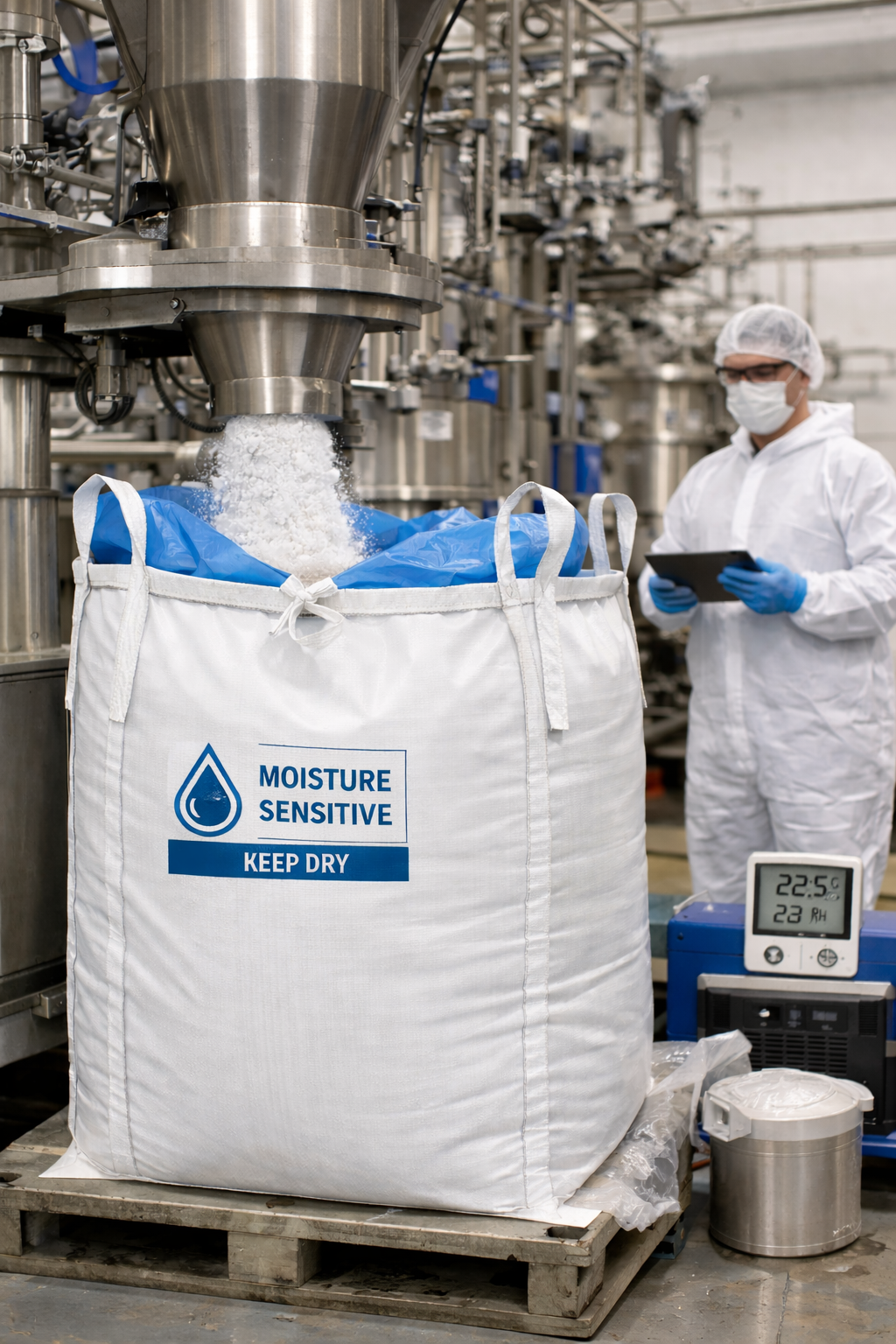
Understanding moisture protection starts with the base material. Standard woven polypropylene, the fabric used in every FIBC, is breathable by design. The interlocking tape structure that gives bulk bags their strength also allows air and vapor to move through the weave. For many applications, this breathability is an advantage. For moisture-sensitive products, it means that an uncoated bag provides no meaningful vapor barrier.
A coated or laminated FIBC applies a thin PP film layer to the fabric surface, reducing vapor transmission and preventing fine powder sifting. This is a significant step up from a standard bag and the right choice for many applications, but it works by slowing moisture movement, not stopping it entirely. In demanding conditions, coating alone is not sufficient for hygroscopic materials.
A lined FIBC provides the strongest readily available barrier, with a separate internal film creating direct protection between the product and the outer fabric. The key is that liner performance depends entirely on fit, seal quality, and handling integrity, all of which must be specified and verified.
The table below shows what each configuration reliably prevents:
Configuration | Vapor Transmission | Humidity Ingress | Direct Water Contact | Condensation |
Standard (uncoated) | ✗ No barrier | ✗ No barrier | ✗ No barrier | ✗ No barrier |
Coated / laminated | ✓ Reduced | ✓ Reduced | ✗ Not prevented | ✗ Not prevented |
Lined (PE liner) | ✓ Good barrier | ✓ Good barrier | ✓ If sealed | ✓ If sealed |
Coated + lined | ✓ Strong barrier | ✓ Strong barrier | ✓ If sealed | ✓ If sealed |
Aluminum barrier liner | ✓ Maximum | ✓ Maximum | ✓ If sealed | ✓ If sealed |
The phrase “if sealed” appears throughout because barrier performance depends on the weakest point in the complete system. The sections below identify where those points are and how to address them.
Moisture protection works as a system, not a single product feature. There are six distinct points where the specification needs to be precise to deliver full protection, and understanding each one helps buyers make better decisions from the start.
Coating meaningfully reduces vapor transmission through the weave, and for most standard applications, it performs well. In environments with sustained high humidity, or during storage periods measured in weeks rather than days, vapor can still gradually permeate even laminated fabric, which is why demanding applications benefit from a liner in addition to coating.
It’s also worth understanding the distinction between coated and breathable FIBCs, which are intentionally uncoated to allow controlled airflow, the right choice for fresh produce or materials that need ventilation, but not for moisture-sensitive products.
Stitched seams, while structurally strong, are not sealed seams. The needle holes and thread channels along seam lines can allow vapor and fine particles to pass through, something that matters primarily for fine powders below 125 microns or hygroscopic materials in high-humidity conditions.
Dust-tight seam construction, using tighter stitch patterns or seam taping, closes this pathway. It’s a specification detail that should be explicitly requested for sensitive applications, and one that Codefine can engineer into any bag design.
A well-specified liner material means little if the fit isn’t right. An overly loose liner creates folds and gaps where moisture can accumulate. An overly tight liner may be under stress during filling and prone to splitting at corners under the weight of the material.
Form-fit liners, sized precisely to the FIBC’s internal dimensions, maintain full-bag contact and provide consistent, predictable barrier performance. For moisture-sensitive applications, specifying liner fit, not just liner material, is one of the highest-impact decisions a buyer can make.
Once a bag is filled, the closure method determines how well the interior is protected from ambient air during storage and transit. The FIBC top design , open top, spout top, or duffle top, affects how effectively the liner can be sealed at the fill point.
A heat-sealed liner closure provides near-airtight containment. A tied or knotted closure is functional but allows vapor exchange over extended storage periods. For products with tight moisture specifications, the closure method should be part of the bag specification from the outset.
This is the ingress point most relevant to international supply chains, and one that buyers focused on warehouse conditions often overlook. When filled bags move through environments with significant temperature differentials , from a cool production floor to a warm loading dock, or inside a sea freight container crossing climate zones , the temperature change causes humid air inside the bag to condense as liquid water. In ocean shipping, this is known as “container rain,” and it can deposit moisture directly onto product surfaces regardless of outer bag coating.
FIBCs used for hygroscopic materials in export applications face particularly high condensation exposure. A bag specification that works well in a controlled domestic warehouse may need to be upgraded for a three-week ocean transit, specifically with a sealed liner system designed for temperature cycling, and minimal headspace air at fill.
Moisture can wick upward from concrete floors through pallet boards into the base fabric of bags stored at ground level. This is a gradual process, but over extended storage periods, it can introduce enough moisture to affect base-layer products on a pallet. A slip sheet between the pallet and the bag base is a simple and effective control.
Handling also introduces micro-punctures in liners, from forklift tine contact, surface abrasion, or rough transfers, that are invisible but allow vapor ingress over time. Correct storage and handling practices, combined with a pre-fill liner inspection, protect the liner’s integrity from filling through to final delivery.
Not all products are equally sensitive. The following categories typically require more than a basic coated bag and benefit from a more complete system specification:
Material Category | Risk Level | Key Concern | Recommended Configuration |
Hygroscopic powders (salts, sugars, fertilizers, detergents) | High | Active moisture absorption | Coated + sealed PE liner |
Cement and cementitious products | High | Irreversible reaction with water | Coated + form-fit liner |
Food ingredients (flour, starch, spices, milk powder) | High | Caking, microbial risk, moisture specs | Food-grade coated + sealed liner |
Pharmaceutical raw materials | Very high | Regulatory moisture limits, degradation | Pharma-grade aluminum barrier liner |
Specialty chemicals | Variable | Reactivity with water or oxygen | Engineer to the application |
Agricultural grains and seeds | Moderate | Mold, germination, spoilage risk | Coated or lined, depending on duration |
Construction minerals (sand, aggregates) | Low | Generally tolerant | Standard or coated |
Effective moisture protection means specifying the full system, not just the bag type. Each recommendation below addresses one of the six points covered above.
Base your specification on supply chain conditions, not just product type. Transit route, seasonal humidity, storage duration, and whether the product moves by sea or road all affect the barrier level required. A specification that works well in summer domestic storage may need to be revisited for winter ocean freight.
Choose form-fit liners for hygroscopic and high-value materials. Tubular liners work well in controlled conditions but are more prone to shifting during filling. Form-fit liners maintain consistent contact with the bag interior throughout the fill and discharge cycle.
Seal the liner closure at the top. Heat-sealed liner closures provide near-airtight containment after filling. This single step significantly improves performance in storage and transit without adding complexity to the handling process.
Specify dust-tight seam construction for fine powders and humidity-sensitive applications. This is a design parameter, not a standard feature; it needs to be requested and confirmed with the manufacturer.
Account for temperature cycling if the product moves by sea. Ocean shipments should be treated as high-condensation environments. Sealed liner systems, minimized headspace air, and if appropriate, desiccant packs all reduce condensation exposure during transit.
Elevate bags off the ground and inspect liners before filling. These are low-cost, high-impact controls that protect the integrity of even the best-specified liner system through storage and handling.
For most moisture-sensitive applications, a lined FIBC with an inner PE liner and uncoated outer fabric is the most practical and reliable solution. The liner creates a direct barrier between the product and the environment, protecting against humidity, vapor transmission, and condensation, while the breathable outer fabric maintains structural performance and allows the bag to flex naturally during handling.
The key variables that determine how well a lined FIBC performs are liner fit, liner material, and closure method, not whether the outer fabric is coated. A form-fit PE liner, correctly sized and heat-sealed at the top, delivers strong moisture protection across a wide range of applications: food ingredients, agricultural products, hygroscopic chemicals, and standard bulk materials with moderate moisture sensitivity.
For applications requiring maximum vapor and oxygen barrier performance, pharmaceutical raw materials, highly hygroscopic specialty chemicals, or products with regulatory moisture limits, an aluminum barrier liner provides the highest level of protection available within the lined FIBC format.
The distinction that matters most in practice is not coated versus uncoated outer fabric, but whether the liner system is correctly specified, correctly fitted, and correctly sealed for the product and supply chain involved. A well-engineered lined FIBC with a heat-sealed form-fit liner outperforms a coated bag without a liner in nearly every demanding moisture scenario.
At Codefine, moisture protection is designed into the bag as a complete system. That means liner fit is sized to internal dimensions, seam construction is matched to product sensitivity, closure options are selected for the required seal level, and the full supply chain journey, including sea freight and temperature cycling, is factored into every specification.
Our team works directly with procurement and quality managers to identify the right configuration for each product and application. Whether you’re specifying protection for a new product line or looking to strengthen an existing packaging setup, we bring the technical depth to recommend the right liner material, seam construction, and closure design, with polyethylene liner options.
For products moving through international supply chains, we also offer guidance on container liner solutions that protect bulk cargo at the container level, an additional layer of assurance for high-value or highly sensitive materials.
Contact Codefine to discuss your moisture protection requirements, or request a quote tailored to your product and supply chain.
Are coated FIBCs waterproof?
Coated FIBCs have a thin PP film layer that significantly reduces vapor transmission, but they are not fully waterproof. For complete moisture isolation, a properly fitted and sealed liner is the recommended addition, particularly for hygroscopic materials, fine powders, or export shipments.
What is the difference between a coated and a lined FIBC?
A coated FIBC has a laminated film applied to the outer fabric, reducing vapor transmission through the weave. A lined FIBC has a separate internal film bag, typically PE, that creates a direct barrier between the product and the fabric. Both have their place; the right choice depends on the product’s moisture sensitivity and storage conditions.
Why might a product still cake even when using a moisture-resistant bulk bag?
Caking can indicate that moisture is reaching the product through one of several pathways: an incorrectly fitted or unsealed liner, vapor entry through stitched seams, condensation during temperature cycling in transit, or ground-contact moisture wicking through the bag base. A systematic review of each point in the packaging chain usually identifies the source.
See how our products can improve your operations and drive your success.
Get in touch to find out how Codefine can support your business with tailored solutions and expert guidance.