
Home » Posts Page » Blog » Codefine » FIBC Dust Control for Fine Powders: Liners, Seams and Filling Design
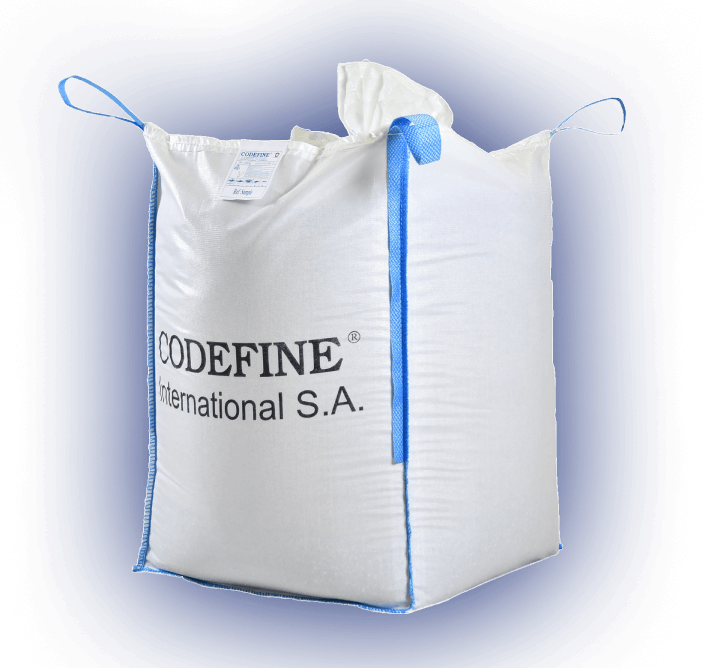
Getting dust under control comes down to three separate decisions: what liner sits inside the bag, how the seams are built, and how the bag gets filled and discharged. Get one wrong and the other two won’t save you.
Woven polypropylene fabric looks solid. Up close, it’s tape yarns woven over and under each other, and that weave leaves gaps between the threads. Granular products, pellets, and most aggregates are too large to find those gaps. Cement dust, milled minerals, fine chemical powders, and flour-grade materials are not. They work through the weave under their own weight, and vibration during a truck or rail journey pushes more of it out over time.
Static makes the problem worse. Fine powder generates a charge as it moves against fabric during filling, and that charge attracts particles to the bag’s inner and outer surface alike, including the seams, which is exactly where a plain woven bag is weakest to begin with.
That combination, a permeable weave plus a seam that was never built to be airtight, is why a bag that holds sand without issue still needs re-engineering for something like fumed silica or micronized fertilizer.
A continuous polyethylene film liner solves the weave problem directly, because a film has no gaps to work through. Two ways to get that barrier: fit a separate PE liner inside a standard woven bag, or specify a coated FIBC, where a thin polypropylene lamination is fused onto the fabric itself and seals the weave from the outside.
Coated fabric costs less and adds no extra step at filling, which is why it covers a lot of moderate-dust applications. A separate liner earns its keep when the product is fine enough to demand a true film barrier, when it needs to stay isolated from the woven fabric for contamination reasons, or when the liner has to be heat-sealed at the neck to match a spout instead of just folded over. A liner that isn’t sealed at the spout is a liner with a hole in exactly the spot most of the dust comes from.
Codefine’s own breakdown of PE liner construction for bulk bags goes deeper into gauge, sealing methods, and where a liner outperforms a coating.
Most sift-through happens at the seams, not through the open weave of the fabric walls. Every stitch is a needle hole, and needle holes stay open even when the thread around them is tight. A bag can pass visual inspection with clean, even stitching and still leak fine powder along every seam line.
Three ways to close that gap. Reinforced, tightly set stitching cuts the sift rate but doesn’t eliminate it, and it’s usually enough for fine granular product that isn’t truly micron-scale. Taping or covering the seam on the inside with an additional strip of fabric blocks the needle holes from the product side. For the finest and most sensitive powders, a heat-sealed seam skips stitching altogether and fuses the fabric or coating directly, which is the only approach that gets close to airtight.
Seam count and geometry matter too. A standard pillow-style bag has fewer seams than a baffled bag, where internal panels add extra stitch lines to hold the square shape during filling. That’s a real tradeoff: baffle construction keeps a load stable and stacks better, but every additional seam is another place dust can find its way out unless it’s sealed to the same standard as the rest of the bag. Codefine’s guide to baffle bag construction covers where that stability is worth the extra seam work.
Dust doesn’t leak evenly over a bag’s life. It escapes hardest at two points: the second the product goes in, and the second it comes out.
An open-top bag gives product nowhere to go but straight down into open air, and a fine powder in free fall throws up a visible plume before it ever settles. A spout top with a closure, tie, or clamp keeps the fill point sealed to whatever’s feeding it, so the powder never gets a chance to become airborne in the first place. A duffle top splits the difference: easier to fill than a spout, tighter than a fully open top, though not as controlled as a proper sealed spout for the finest materials. Where the fill volume and dust sensitivity justify it, a tapered or conical spout narrows the stream further and cuts the plume down more than a straight cylindrical one does.
Discharge deserves the same attention. A bottom spout that’s tied or clamped shut until the bag is positioned over the process point keeps dust contained right up to the moment of use, and if there’s an inner liner, its own discharge sleeve should tie off independently of the outer spout rather than relying on the outer fabric to hold the seal.
Fine powder isn’t only a housekeeping problem. Below a certain particle size, many materials that seem completely inert become combustible dust, and a static discharge inside or around the bag can be the ignition source. NFPA 654 and NFPA 652 both address FIBCs specifically for this reason, and the FIBC industry classifies bags into four types based on how they handle static.
Type A is plain woven fabric with no static protection at all, fine only for non-combustible products with no flammable vapor nearby. Type B uses fabric with a low breakdown voltage to prevent the more dangerous spark discharges, but it doesn’t bleed off charge on its own, so it’s limited to dry combustible powders away from flammable vapors. Type C, often called conductive or groundable, weaves conductive threads through the fabric in a grid and must be connected to an earth ground during both filling and discharge, tested to a resistance well under the threshold set by IEC 61340-4-4. Type D uses static-dissipative yarns that release charge safely through low-energy corona discharge and needs no grounding connection at all, which makes it the practical choice in a lot of flammable-vapor environments where hooking up a ground clamp every cycle isn’t realistic.
The liner and seam decisions above don’t sit apart from this one. Dropping a plastic liner into a Type C bag without checking the fit can break the conductive path between the product and the ground tab, which defeats the entire point of specifying a Type C bag. Any combination of liner, seam treatment, and static-protection type needs to be verified together, not chosen as three separate line items, and the starting point should always be a proper dust hazard analysis rather than a guess based on how the product looks in your hand. Codefine’s piece on FIBC specs for fertilizer and agrochemical packaging walks through how static classification and liner choice interact on a product family where both routinely apply.
Start with the hazard, not the fabric. Run or reference a dust hazard analysis to find out whether the product is a combustible dust risk, and let that answer decide the FIBC type: Type C where grounding infrastructure exists at both filling and discharge points, Type D where it doesn’t. Only after that’s settled does it make sense to pick the liner, since the liner has to fit inside whichever static-protection type you’ve landed on without breaking its conductive or dissipative path.
From there, match the liner to the particle size. A coated fabric handles moderate dust loads at lower cost. A true separate liner, heat-sealed at the neck, is worth the extra step once the product is fine enough that weave gaps alone would let it through. Seam treatment follows the same logic: reinforced stitching for fine granular product, taped or covered seams for finer powders, heat-sealed seams when you’re dealing with something close to airborne on contact.
Finish with the fill and discharge points, since that’s where a bag with a great liner and great seams can still lose the fight. A closed spout with a tapered profile beats an open top every time dust matters, and a discharge spout that stays tied until the bag is in position closes the last gap in the system.
Why does powder leak through a bag rated for fine materials?
Most sift-through happens at the seams rather than through the fabric itself. Needle holes from stitching stay open even with tight thread tension, and static charge pulls fine particles toward those seam lines during filling and transit, which is why a bag that looks properly sealed can still lose product along every stitch line.
Do I need a separate liner, or is a coated FIBC enough?
Coated fabric, where a polypropylene lamination is fused onto the weave, handles moderate dust loads at a lower cost and works for a large share of applications. A separate PE liner earns its cost when the product is fine enough to demand a true film barrier, when it needs to stay isolated from the outer fabric, or when the liner itself needs to be heat-sealed at the spout for a tighter fit than a coating alone provides.
What’s the difference between Type C and Type D FIBC for combustible dust?
Type C bags weave conductive threads through the fabric and must be connected to an earth ground during both filling and discharge to safely move the static charge away. Type D bags use static-dissipative yarns that release charge on their own through low-energy corona discharge and need no grounding connection, which makes them the more practical option where a reliable ground point isn’t available at every step of the process.
Can I add a liner to a Type C conductive bag?
Yes, but the liner has to be fitted so it doesn’t interrupt the conductive path between the product and the bag’s grounding tab. That combination needs to be verified as a system, tested to the resistance thresholds in IEC 61340-4-4, rather than assumed safe just because each component works on its own.
Does spout design really change how much dust escapes during filling?
It does. An open top lets fine powder fall freely and throw up a visible plume before it settles. A spout top with a closure keeps the fill point sealed to the feed source, and a tapered or conical spout narrows the stream further, which cuts down the plume more than a straight cylindrical opening does.
Liner, seam, and filling design aren’t three separate specs to fill in on a form. They work as a system, and a static-protection requirement or a genuinely fine particle size changes what the other two need to look like. Describe the product, its particle size, and whether it carries a combustible dust classification, and the right combination usually narrows fast.
If you’re not sure where your product falls, Codefine’s FIBC specialists can help you spec the liner, seam, and spout combination before the first batch ships, not after dust turns up somewhere it shouldn’t.
See how our products can improve your operations and drive your success.
Get in touch to find out how Codefine can support your business with tailored solutions and expert guidance.