
Home » Posts Page » Blog » Products and Materials » How Fill Rate and Discharge Speed Affect FIBC Bag Selection
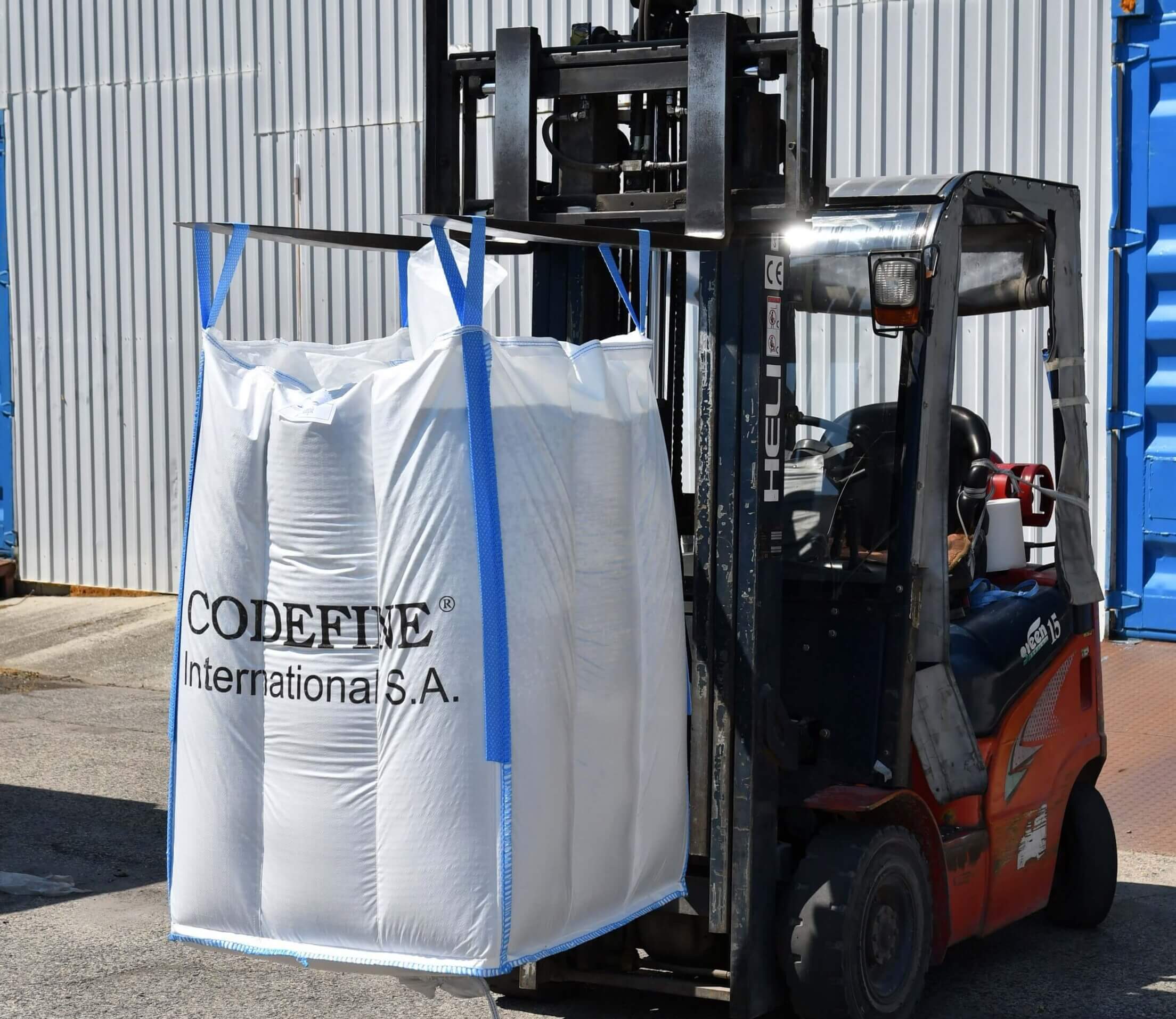
Before any bag specification matters, you need to understand how your product moves. Material flow characteristics determine which discharge configuration will work, what spout diameter is appropriate, and whether the bag geometry will cause problems during filling or emptying.
Free-flowing granules, plastic pellets, coarse salt, dry grain, move predictably. Open a discharge spout and gravity does most of the work. These materials work with a wide range of configurations because they do not resist flow.
Fine powders and cohesive materials behave differently. When a cohesive powder is loaded into a bag, the particles compact under their own weight and under the pressure of filling. During discharge, two failure modes become common: bridging and ratholing. Bridging happens when compacted particles form a stable arch across the discharge spout opening, blocking flow entirely. Ratholing happens when a narrow channel opens directly above the spout while the surrounding material stays locked in place, the bag appears to be discharging but only a fraction of the product is actually moving. Both problems waste product, slow operations, and often require manual intervention to clear.
The practical implication: if your product is a fine powder, a hygroscopic material that clumps under humidity, or a material with irregular particle shapes, your bag specification has to account for flow failure from the outset, not as an afterthought when your discharge station stalls. The different types of FIBC bags available, from standard tubular to baffle to conical, exist precisely because different materials require different structural approaches to flow.
For a closer look at how discharge configurations translate to different materials, the FIBC discharge options guide covers the full range and their applications.
The top of the bag determines how the product enters it. Get this wrong, and you lose time, product, and weight accuracy at every fill cycle.
Open tops are the simplest configuration. The bag is placed under a fill head, and the product drops in freely. They work well with coarse, free-flowing materials that do not produce significant dust and do not require precise fill weight. The limitation is control, there is no seal between the fill head and the bag, which creates dust exposure and weight inaccuracy for fine materials.
Spout tops are the standard for automated and semi-automated filling lines. The fill spout fits over the filling machine head, creating a close or sealed interface that contains dust and improves weight accuracy. Standard automated fill heads use spout diameters in the range of 140 to 180 mm, if the bag’s spout diameter does not match the fill head, dust escapes around the gap and fill rate accuracy drops. For fine powders, the spout diameter also matters for another reason: a spout that is too narrow relative to the bag’s body creates a shoulder, meaning product has to compress to pass through the neck rather than settling directly into the corners of the bag. This causes uneven fill distribution, soft shoulders, and bags that lean when placed on a pallet.
Duffle tops provide a large, flexible opening that gives the most filling flexibility and works across a wide range of fill head types and product characteristics. They are common in operations that handle multiple product types or use mobile filling equipment rather than fixed automated lines.
The FIBC filling and bagging essentials guide covers how filling station design interacts with bag top configuration in more detail.
Yes, and this is a specification detail that frequently gets ignored.
Standard circular or tubular FIBCs bulge outward when filled. As the bag fills from the bottom up, the circular cross-section means the corners remain slack while the centre fills first. Product does not distribute evenly across the bag base, which creates an unstable filled shape and means the bag’s full volume is rarely used. More relevant to fill rate: the uneven fill distribution can cause the fill head to sense the bag as full before it actually is, or create inconsistent weight readings on load cell filling stations.
Baffle bags maintain a square cross-section throughout filling because the internal baffles hold the corner fabric taut. Product distributes evenly across the full base area as the bag fills, the fill weight is consistent with the bag volume, and the filled shape is stable enough to be placed on a pallet without leaning. For operations running automated filling lines where fill weight accuracy matters, baffle bags produce more consistent results and reduce the need for post-fill adjustment.
The discharge spout is where most fill-and-discharge problems originate. Its diameter determines the maximum flow rate and the likelihood of bridging for cohesive products.
A discharge spout that is too short or too small in diameter creates backpressure during discharge. For fine powders in particular, this is where bridging starts. The particles at the outlet point compact under the weight of product above them, and if the spout is narrow, the cohesive forces between particles can exceed the force of gravity at that point, a stable arch forms and flow stops.
Common discharge spout diameters range from 25 cm to 60 cm for standard applications. Wider spouts reduce the likelihood of bridging because the arch must span a wider gap to form, which requires more cohesive force than most bulk materials can generate. For products with known bridging tendencies, certain food powders, hygroscopic chemicals, fertilizer granules with high moisture content, specifying a wider spout diameter is one of the most straightforward interventions. For materials where moisture absorption is itself contributing to bridging, understanding what a moisture barrier material does in the bag specification is a useful parallel consideration.
Spout length also affects discharge. A short spout limits how far the bag can be lowered onto discharge equipment and reduces the operator’s ability to control flow by pinching or tying off the spout between batches. Spout lengths typically range from 40 cm to 90 cm. For applications where controlled, metered discharge is needed, a longer spout gives more room to work.
Flat-bottom FIBCs are the standard configuration. They sit stably on pallets, stack predictably, and work well for free-flowing materials that empty cleanly through a spout. The limitation appears with products that do not flow readily, flat corners create dead zones where product settles and does not reach the discharge spout. For fine powders and sticky materials, a flat bottom commonly results in significant residual product that cannot be recovered without manual intervention.
Conical or cone-bottom FIBCs solve this by shaping the bag base into a funnel that directs all product toward the discharge point. The geometry means there are no flat corners for product to settle in, everything flows toward the outlet. Discharge is faster, more complete, and requires less manual intervention for difficult-flowing materials. The trade-off is that cone-bottom bags need a dedicated discharge frame to support the bag during emptying, because the conical base cannot sit flat on a pallet while discharging.
For operations handling high-value materials where product recovery matters, pharmaceutical powders, food ingredients, specialty chemicals, the residual loss from a flat bottom multiplied across hundreds of cycles is a real cost. The bulk bag unloading guide covers discharge equipment and setup in more detail.
Yes, if it is not specified correctly for the application.
A form-fit PE liner that matches the bag’s internal dimensions closely will move with the bag during discharge and allows product to empty cleanly through the liner spout. A loose tube liner, an unstructured cylinder of PE film with no fitted base, bunches at the bottom during discharge. The bunching restricts the discharge spout opening, reduces flow rate, and causes product to accumulate in the liner folds rather than flowing through cleanly.
For products that require a PE liner for moisture protection, specifying a form-fit liner rather than a generic tube liner preserves discharge performance. The liner spout diameter should also match the bag’s discharge spout diameter, a liner spout that is narrower than the outer spout creates a bottleneck that limits flow rate independently of the outer spout specification.
High-speed automated filling lines can exceed the bag’s ability to receive product evenly if the filling configuration is not matched to the line speed.
Flood feeding, where product is released faster than the bag can settle it, causes overflow at the fill spout, uneven fill distribution, and bags that are overfull in the centre while the corners remain slack. The result is a bag that cannot be properly tied off, has an unstable filled profile, and frequently reads overweight at the check weigher because the product is compressed into the centre rather than distributed across the full volume.
The fix is rarely in the bag specification itself, it is more often in the filling station setup. Vibratory densification, where the bag is vibrated during filling to settle product into the corners, resolves uneven fill distribution for most materials. Pre-inflation of the bag before filling, using a fan to open the bag fully before product enters, ensures the full volume is available from the first kilogram of product in, rather than filling into a partially collapsed bag.
What the bag specification can address: ensure the fill spout diameter is wide enough for the fill head, the liner (if present) is correctly fitted, and the bag construction style matches the filling geometry. Baffle bags are significantly better than tubular bags for high-speed filling because the square geometry maintains volume throughout the fill cycle. How the bag is handled after filling, storage orientation, stacking, and transport conditions, also affects whether the filled profile holds its shape before discharge, which the guide on how to properly store and handle FIBC bags covers in detail.
A bag specification that works well in isolation may still create problems if it does not match the discharge station equipment.
Iris and star closure spouts provide the highest level of discharge control, the closure can be opened incrementally to regulate flow rate and closed again mid-discharge if the receiving equipment backs up. These are the right choice when the downstream process requires metered feed, when the material is high-value and loss during discharge is costly, or when dust control during discharge is a regulatory requirement. For operations handling combustible or flammable materials, the anti-static bulk bags guide covers how static protection type interacts with discharge configuration and equipment grounding requirements.
Full-open or duffle-bottom discharge configurations release the entire bag contents at once. They are appropriate for aggregates, construction waste, and other materials where speed matters more than control and residual loss is not a concern. Connecting a duffle-bottom bag to a receiving system that cannot handle the full-rate discharge creates overflow and spillage at the discharge station.
The decision is ultimately about the downstream process, not just the material. A free-flowing granule that could discharge through any configuration still needs a spout and closure type that the discharge station can accept and control. Before specifying the discharge configuration, confirm what the discharge equipment can handle, spout diameter compatibility, flow rate capacity, and whether the station has a dust containment collar that requires a specific spout length.
For hygroscopic materials where discharge design also affects moisture exposure during emptying, the FIBC requirements for hygroscopic materials article covers how to integrate discharge design into a broader moisture management approach.
Why does my bulk bag take so long to discharge?
The most common causes are a discharge spout that is too narrow for the material’s flow characteristics, bridging where compacted product forms an arch over the spout opening, or a bag geometry that leaves product in flat corners out of reach of the discharge point. Wider spout diameters and conical bottom configurations address each of these.
What causes bridging in an FIBC discharge spout?
Bridging happens when cohesive particles form a stable arch across the spout opening. It is most common with fine powders, hygroscopic materials, and products with irregular particle shapes. Wider spout diameters reduce bridging risk. Conical bottoms and discharge frames that allow the bag to be shaken or massaged help clear bridges when they form.
Does bag shape affect fill rate?
Yes. Standard tubular bags bulge outward during filling, which means the product is distributed unevenly and the full volume is rarely used efficiently. Baffle bags maintain a square cross-section throughout filling, which produces more consistent fill weights and works better with automated load cell filling stations.
What is the difference between a form-fit liner and a tube liner for discharge?
A form-fit liner matches the bag’s internal dimensions and moves with the bag during discharge, allowing clean emptying through the liner spout. A tube liner, a plain cylinder of PE film, bunches at the bottom during discharge, restricts the spout, and reduces discharge speed. For applications where discharge performance matters, specify a form-fit liner.
Can I use a full-open discharge bag on a standard discharge station?
Only if the station is designed to handle the full-rate, uncontrolled flow. Full-open and duffle-bottom configurations release the entire bag contents immediately. If the receiving equipment, silo inlet, hopper, conveyor cannot accept that flow rate, the product will overflow the station. These configurations suit applications where speed matters over control.
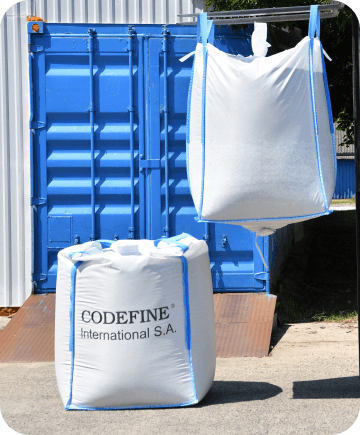
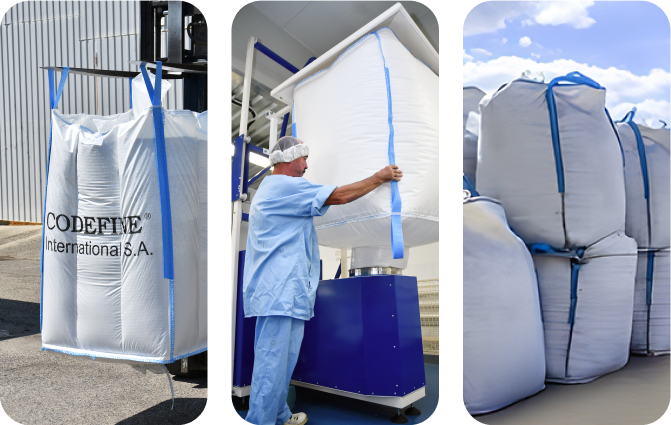
See how our products can improve your operations and drive your success.
Get in touch to find out how Codefine can support your business with tailored solutions and expert guidance.