
Home » Posts Page » Blog » Codefine » How to Choose the Right Liner Material for Your Product
That’s the standard to write to. Not “which liner is best,” because there isn’t one. The right liner material is the one that matches what you’re shipping, how sensitive it is to moisture and temperature, whether it needs to be food grade, and how it gets loaded and discharged at the other end.
This guide walks through the factors that decide the choice, breaks down the common liner materials (PE, woven PP, LLDPE, HDPE, and PET foil laminates), and gives you a way to match a material to your product instead of guessing.
A container liner has one job on paper: keep dry bulk goods separated from a steel container that was probably hauling something else last week. But the material doing that job has to survive a full ocean voyage, temperature swings inside a sealed steel box, the friction of loading equipment, and a discharge method on the other end that can be rough on seams.
Get the material wrong and the failures show up in specific, expensive ways:
Condensation forms inside the container as temperatures cycle between day and night, and a liner with the wrong moisture barrier lets that water reach the product. Grain, feed, and some minerals will cake, mold, or lose grade over a three to six week voyage under those conditions, the same failure mode we walk through in our guide to storing grain safely over long hauls.
A liner rated for general dry goods but used for food or pharmaceutical shipments can trigger a rejected load at customs, because it wasn’t made with FDA-approved resin in the first place.
A thin film liner used with mechanical discharge tears at the seams or the corners, and now you’re paying for cleanup, demurrage, and a claim.
In every case, a supplier matched the wrong material to the job. None of it comes down to liner quality in the abstract.
Before comparing materials, work through these five questions about the product you’re shipping. They cover most of the decision.
How sensitive is the product to moisture? Grain, animal feed, sugar, and some chemical powders absorb water and degrade fast. Minerals, aggregates, and most plastics resins tolerate a lot more. This alone rules half the material list in or out.
Does it need to be food grade or pharmaceutical grade? If the answer is yes, you need liners made from FDA-approved resin, usually LLDPE, and you need documentation to prove it. This isn’t optional and it isn’t something you retrofit after the fact.
Will the container see temperature extremes? Thermal liners exist for a reason. Chocolate, wax, and certain chemicals need protection from heat during transit, and that calls for a different construction than a standard dry bulk liner.
How does the product get loaded and discharged? Gravity discharge through a bottom spout puts different stress on a liner than a mechanical tipper or a front loader scooping product out through an open top. Woven liners handle rough mechanical handling better than film liners do.
Is the liner reused, or is this a one-way shipment? Most bulk container liners are single-use, but some operations reuse liners for internal transport between facilities, and that changes the durability requirement.
Answer those five and you’ve already narrowed the list to two or three realistic options.
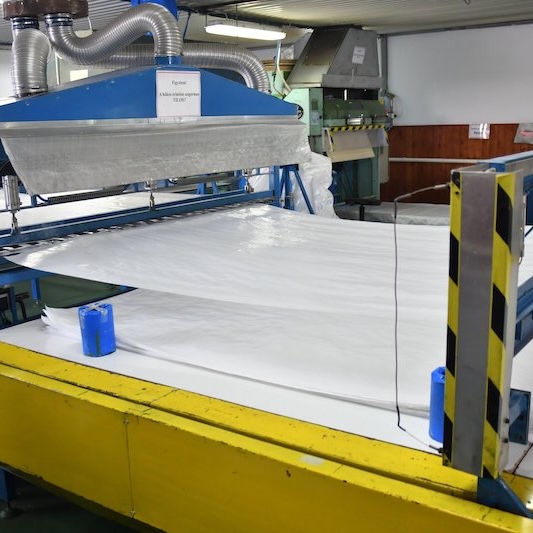
Polyethylene is the workhorse material for standard dry bulk liners. It’s a continuous film, so it forms a solid moisture barrier without stitched seams that could leak. Grades vary. A basic PE liner handles general cargo like minerals or resin pellets, while a heavier gauge film with a better moisture vapor transmission rate (WVTR) rating holds up for longer voyages or more humid routes. We go deeper on film construction and WVTR ratings in how PE film liners hold up over a full voyage.
Best for: dry bulk goods with moderate moisture sensitivity, standard 20ft and 40ft container loading through gravity or pneumatic discharge.
Watch for: film liners are less tolerant of sharp edges, forklift punctures, or aggressive mechanical loading than woven materials.
Woven PP is built from tape yarns woven into a fabric, which gives it tear resistance and load bearing strength that plain film can’t match. It’s the material to reach for when the product is abrasive, heavy, or handled with equipment that would punch through a film liner.
Best for: minerals, construction materials, and any product loaded or discharged with mechanical equipment instead of gravity flow.
Watch for: woven fabric alone isn’t watertight. Most woven PP liners are laminated or coated with PE on the inside to add a moisture barrier, so check the construction. Don’t assume “woven” means waterproof.
LLDPE is the material behind most food-grade and co-extruded liners. It’s flexible, resists punctures better than standard PE film at a comparable thickness, and is available in FDA-approved resin grades for food contact.
Best for: food products, animal feed intended for human-adjacent supply chains, and anywhere you need documented food safety compliance.
Watch for: confirm the specific resin grade and get the FDA compliance documentation before you commit, not after the first shipment is booked.
HDPE woven fabric sits between standard woven PP and heavier industrial fabrics on strength. It’s stiffer than PP, which some operators prefer for structural liners that need to hold their shape during loading.
Best for: heavier bulk products and applications where the liner needs rigidity as well as strength.
For temperature-sensitive cargo, a PET film laminated with aluminum foil gives real thermal performance, closer to airtight sealing than any plastic-only construction manages on its own. Some operations use PE-only thermal liners instead, which cost less but give up thermal performance the foil laminate doesn’t sacrifice.
Best for: chocolate, wax, certain chemicals, and any product where a temperature swing during transit would ruin the load.
If you only remember one thing from this guide, remember the order these questions come in. Start with compliance. Does the product need food grade or pharmaceutical certification? If it does, go straight to LLDPE and don’t look anywhere else until you’ve confirmed the resin grade and gathered the documentation. If compliance isn’t the issue, ask whether temperature control is the priority. Chocolate, wax, and heat-sensitive chemicals point straight to a PET foil thermal liner before you consider anything else. From there, look at how the product gets handled. Abrasive cargo or mechanical loading and discharge pushes the decision toward woven PP or HDPE. Moisture-sensitive product moving through gentle gravity discharge usually just needs standard PE film, sized to the WVTR rating that fits your route and voyage length. Whatever’s left, antistatic requirements for combustible dust, or a need for conductive grade, layers on top of whichever base material you’ve already landed on.
Most shipments only need one or two of these factors to make the decision obvious. The harder cases are the ones where a product is both food grade and abrasive, or both moisture sensitive and temperature sensitive, and that’s exactly when it’s worth getting a liner supplier involved before you finalize the spec instead of after a load gets rejected.
What’s the difference between PE and PP liner material?
PE (polyethylene) is a continuous film that forms a solid moisture barrier with no seams. PP (polypropylene) is woven into a fabric that’s stronger and more tear resistant but needs a coating or lamination to be watertight on its own. PE suits moisture-sensitive cargo under gentle handling. Woven PP suits abrasive or mechanically handled cargo.
Is container liner material food safe?
Only liners made from FDA-approved resin, usually LLDPE, qualify as food grade, and only when the supplier can document the resin grade and compliance. A general-purpose PE or PP liner is not automatically food safe because it’s food-colored or clean.
How do I know if a liner’s moisture barrier is strong enough?
Ask for the WVTR (water vapor transmission rate) specification and compare it against your route’s typical humidity and voyage length. A liner rated for a two-week domestic haul isn’t necessarily rated for a six-week transoceanic voyage through tropical humidity.
Can container liners be reused?
Most bulk container liners are designed for single use because the material takes damage during loading, transit, and discharge that isn’t visible from the outside. Reusable liner systems exist for controlled internal transport, but they’re a different product category from standard dry bulk liners.
If you’re not sure which category your product falls into, Codefine’s container liner specialists can help you spec the right material before the first container ships, not after something goes wrong.
See how our products can improve your operations and drive your success.
Get in touch to find out how Codefine can support your business with tailored solutions and expert guidance.