
Home » Posts Page » Blog » UN FIBC Recertification and Reuse: What’s Permitted and What Isn’t

Two errors come up repeatedly in operations that handle UN-certified bags. The first is treating single-trip bags as if they can be reused for a second hazardous goods shipment on the assumption that the bag still looks fine. The second is letting the supplier’s annual design-type recertification lapse without noticing, which converts the bag from compliant to non-compliant on a calendar date, even though nothing physically changes about the bag.
This article works through what UN recertification means, the difference between single-trip and multi-trip bag construction, the conditions under which multi-trip bags can legitimately be reused, and the practices that are not permitted under UN rules, regardless of how cost-effective they might appear.
FIBCs are designed and manufactured to one of two service-life expectations. Single-trip bags are built for a single fill-discharge cycle and disposed of after use. Multi-trip bags are built to withstand multiple cycles, with higher safety factors, stronger seam constructions, and components designed to tolerate the additional wear of repeated handling, cleaning, and inspection. The designation is set at the bag’s design type and reflected in the testing standards against which the bag was certified.
The safety factor on an FIBC indicates how many times the rated safe working load the bag has been tested to hold before failure. Single-trip FIBCs are certified to a 5:1 safety factor. Multi-trip FIBCs are certified to 6:1 or higher because the additional fatigue exposure across multiple cycles requires more margin between operating load and failure load. For a full explanation of what those numbers mean in practice, the FIBC safety factors guide covers the testing methodology and the real-world implications for load planning.
A bag manufactured to a 5:1 safety factor does not have the structural margin to support multiple cycles. Cleaning it, repairing minor damage, and putting it back into service do not increase its safety factor. The bag still has the same fabric weight, the same seam construction, and the same loop attachment as when it was manufactured. Returning it to service for a second hazardous goods cycle means using a bag that was not designed or tested for that service. Only bags designed and certified for multi-trip service can be legitimately refurbished and reused.
UN certification of an FIBC design type is granted for a defined period – typically one year – after which the design must be re-tested to confirm continued compliance. Recertification testing repeats the full battery of UN tests applied at original certification: top lift, drop, stacking, topple, righting, tear, and vibration testing under maximum-load conditions. The same accredited laboratory that performed the original testing usually handles recertification, though a different accredited lab is also acceptable. The purpose is to confirm that the manufacturing process continues to produce bags that match the design type as originally tested. For a detailed breakdown of what each of those physical tests verifies, the FIBC testing methods article covers the full battery with pass criteria.
The UN design-type certification is held by the manufacturer, not the end user. Your responsibility as the user is to verify, at receiving and at any other review point in the bag’s life, that the bag carries a current, valid certification. This means requesting current certification documentation from the manufacturer, not assuming that a marking applied at manufacture remains valid years later. Codefine maintains current UN certification on all hazardous-goods design types we manufacture, with documentation available for each batch shipped.
If a manufacturer fails to recertify a design type on schedule, bags manufactured after the lapse date are not properly UN-certified, even if they are physically identical to bags manufactured before the lapse. The marking on the bag still appears to claim certification, but the underlying design-type approval is no longer in effect. Requesting current certification documentation on each significant delivery, and verifying the certification date against the bag’s manufacture date, catches a lapsed certification at receiving before non-compliant bags enter inventory. This check is part of the receiving inspection process for UN-certified FIBCs and takes minutes to perform against the certificate documentation.
Multi-trip FIBC reuse is generally limited to closed-loop systems, where the bag’s lifecycle is controlled end-to-end. In a closed-loop system, the bag goes from the manufacturer to the filler, from the filler to the consignee, and back from the consignee to a refurbishment operation for cleaning, inspection, and return to service. The same product travels in the same bag across multiple cycles.
Open distribution – where a bag ends up in a third-party warehouse or wholesale operation – does not support multi-trip reuse for hazardous goods because the bag’s history and condition cannot be reliably documented after it leaves the controlled lifecycle. Even multi-trip-designed bags in open distribution typically serve a single hazardous goods cycle and then get retired or downgraded to non-hazardous service.
Between trips, a multi-trip FIBC has to be inspected for damage, cleaned to remove product residue, and re-tested where the inspection findings indicate it. Inspection covers the same elements as receiving inspection on a new bag: fabric condition, seam integrity, loop attachment, spout condition, liner presence and condition for 13H3 bags, and marking legibility. Cleaning protocols depend on the product the bag has carried. Some hazardous products are not compatible with cleaning at all, and bags used to carry those products are not candidates for refurbishment under any condition.
The simplest reuse scenario is the same product in the same bag across multiple cycles. The bag is designed for the product, compatibility is established, and inspection and cleaning protocols are well understood. Reuse becomes more complicated when the product changes between cycles, introducing compatibility, classification, and certification questions that each need to be resolved before the bag re-enters service. Most operations that run multi-trip bags reserve the multi-trip status for a single product and use single-trip bags for everything else.
Refurbishment of multi-trip FIBCs follows international standards, including ISO 21898, which governs FIBCs for non-dangerous goods, and the related rules for hazardous goods bags under the UN framework. The FIBCA (Flexible Intermediate Bulk Container Association) publishes industry guidelines for refurbishment. Both the standards and the guidelines specify that only bags designed for multiple use, with a minimum 6:1 safety factor for hazardous goods reuse, can be refurbished. Bags manufactured for single-use service are explicitly excluded.
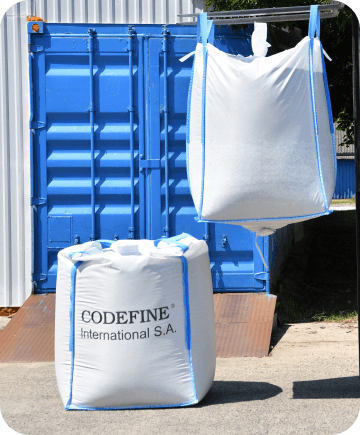
A typical refurbishment cycle runs in four phases. Cleaning removes product residue using methods appropriate to the product type. Inspection assesses the bag against the original design specification and identifies any defects. Repair addresses minor defects within scope; major defects retire the bag. Re-testing, typically a top lift test against the original safety factor, confirms the refurbished bag still meets the certified design performance. The repair scope is deliberately narrow – major structural damage is generally not repairable in a way that preserves the bag’s certification. The FIBC bag failures guide covers the failure modes that typically arise from inadequate inspection between cycles and what they look like before they become a serious problem.
Each refurbishment cycle generates documentation that follows the bag forward: inspection findings, the cleaning protocol used, repairs performed, test results, and the cycle count. Bags carry markings or labels that show the cycle number alongside the original UN marking. The documentation matters for traceability and for regulatory audit. If a refurbished bag fails in service, the documentation lets investigators determine which cycle the bag was on and whether the failure pattern points to a refurbishment process issue.
The clearest prohibition in UN FIBC reuse rules is reusing single-trip bags for a second hazardous goods cycle. A bag designed and certified to a 5:1 safety factor for single-trip service does not have the engineering margin to support a second cycle, and refurbishing it does not change that. Reusing it for hazardous goods after its single-trip service voids the UN certification and creates a compliance violation. This rule applies regardless of how the bag looks at discharge. A single-trip bag that arrived at the consignee with no visible damage is a single-trip bag that was used correctly – not a multi-trip bag.
The US DOT’s 49 CFR rules align closely with the UN Model Regulations but include some US-specific elements. The ADR rules for European road transport add unique placard formats and document requirements. The IMDG Code for international ocean transport layers on requirements around stowage segregation and emergency response information. The IATA Dangerous Goods Regulations for air freight are the most restrictive, with weight limits and packaging combinations that differ significantly from ground and sea transport rules. For an FIBC shipment moving through multiple jurisdictions and modes, the labeling needs to satisfy the most restrictive requirement at each leg. The role of packaging in transporting goods off-site covers modal considerations and documentation requirements that apply at handover points.
The proper shipping name on hazardous goods labeling must appear in specific languages depending on the destination and regulatory framework. The ADR requires the shipping name in one of the official languages of the origin country, plus English, French, or German if those are not the origin language. The IMDG Code typically requires English. National rules may add further language requirements. For shipments with predictable destinations, build the language requirements into the standard label template and apply them at origin – retrofitting translations after labels are printed creates errors.
The most common labeling findings include: UN marking elements that are missing or illegible; hazard class placards that are absent, the wrong class, or too small; proper shipping names that do not match the UN number or use trade names instead of regulated shipping names; missing packing group information; and language requirements not met for the destination jurisdiction. Each of these is straightforward to detect during a documentation review or visual inspection. Carriers screen for them at acceptance because they do not want responsibility for a non-compliant shipment in transit.
A labeling error caught at carrier acceptance typically results in the shipment being refused or held pending correction. The corrective action ranges from re-labeling at origin (cheapest, if correction happens before the truck leaves) to re-labeling at the carrier’s facility to returning the shipment entirely. A labeling error caught at customs is more expensive still. Customs holds the shipment, charges storage fees, and requires the shipper or consignee to arrange corrective action before release. For hazardous goods, customs holds may also trigger regulatory reporting requirements that flag the operation for closer scrutiny on future shipments. The true cost of FIBC compliance failures examines how documentation and labeling errors compound into operational costs that far exceed the original error.
A pre-shipment labeling check should confirm, before the bag leaves the loading dock, that the UN marking is present and complete; the marking matches the product’s classification (bag type appropriate to the product, packing group rating covering the product’s group, maximum gross mass not exceeded by the fill weight); the hazard class placard is the correct class, correctly sized, and correctly placed; the UN number and proper shipping name are present and match the safety data sheet; any required subsidiary hazard placards are present; language requirements for the destination are met; and the labels are durable enough to survive the expected transit route and duration.
For operations shipping the same hazardous product repeatedly, labeling requirements should live in the bag specification document, not in per-shipment memory. The specification should record the UN number, the proper shipping name in all required languages, the hazard class and any subsidiary classes, the packing group, the bag type and rating required, and the labeling layout including placement positions on the bag. With labeling captured in the specification, suppliers can pre-print certain elements at manufacture, and pre-shipment checks become verification against a documented standard rather than re-derivation from scratch each time. This approach also supports the receiving inspection process – when labeling requirements are written down, the inspection team knows exactly what to check for.
Hazard placards and labels should appear on at least one face of the FIBC, visible during normal handling, on a side panel rather than the top or bottom of the bag. For larger bags or configurations that may obscure one face, applying placards to two opposing faces ensures visibility from multiple angles. Apply labels to flat panels, not across seams or folds where distortion obscures them. Placing all compliance information – UN marking, hazard placards, shipping name label – on the same panel creates a single inspection area that carriers and customs officials can verify at a glance.
On label reuse: for single-trip UN-certified FIBCs, the bag is used once and disposed of; labels go with the bag. For multi-trip FIBCs in closed-loop systems, the bag may return to the shipper, get cleaned, and be refilled for the same product – in which case label legibility needs to be verified at each refill cycle. If the bag is being refilled with a different product, even one with the same hazard classification, the labels need to be reviewed and updated before the bag re-enters service.
Labeling discipline for hazardous goods FIBCs is the operational layer that sits between bag certification and shipment release. The UN marking certifies the bag. The hazard labels identify the contents. The orientation marks direct safe handling. Each layer has specific requirements, and missing any one of them creates a compliance gap that carriers and customs are equipped to detect. Building labeling into your specification, verifying it at pre-shipment, and keeping the records that prove you did both is the practical work that keeps hazardous goods shipments moving.
Codefine manufactures UN-certified FIBCs with the UN marking pre-applied during manufacture and provides supporting documentation that links each bag batch to its certification. If you are setting up a labeling program for a new hazardous product, reviewing your current process against the requirements above, or working through a specific cross-border labeling question, get in touch to start the conversation.
See how our products can improve your operations and drive your success.
Get in touch to find out how Codefine can support your business with tailored solutions and expert guidance.