
Home » Posts Page » Blog » Domestic vs. Overseas FIBC Sourcing: Lead Times, Quality Control, and Cost Tradeoffs
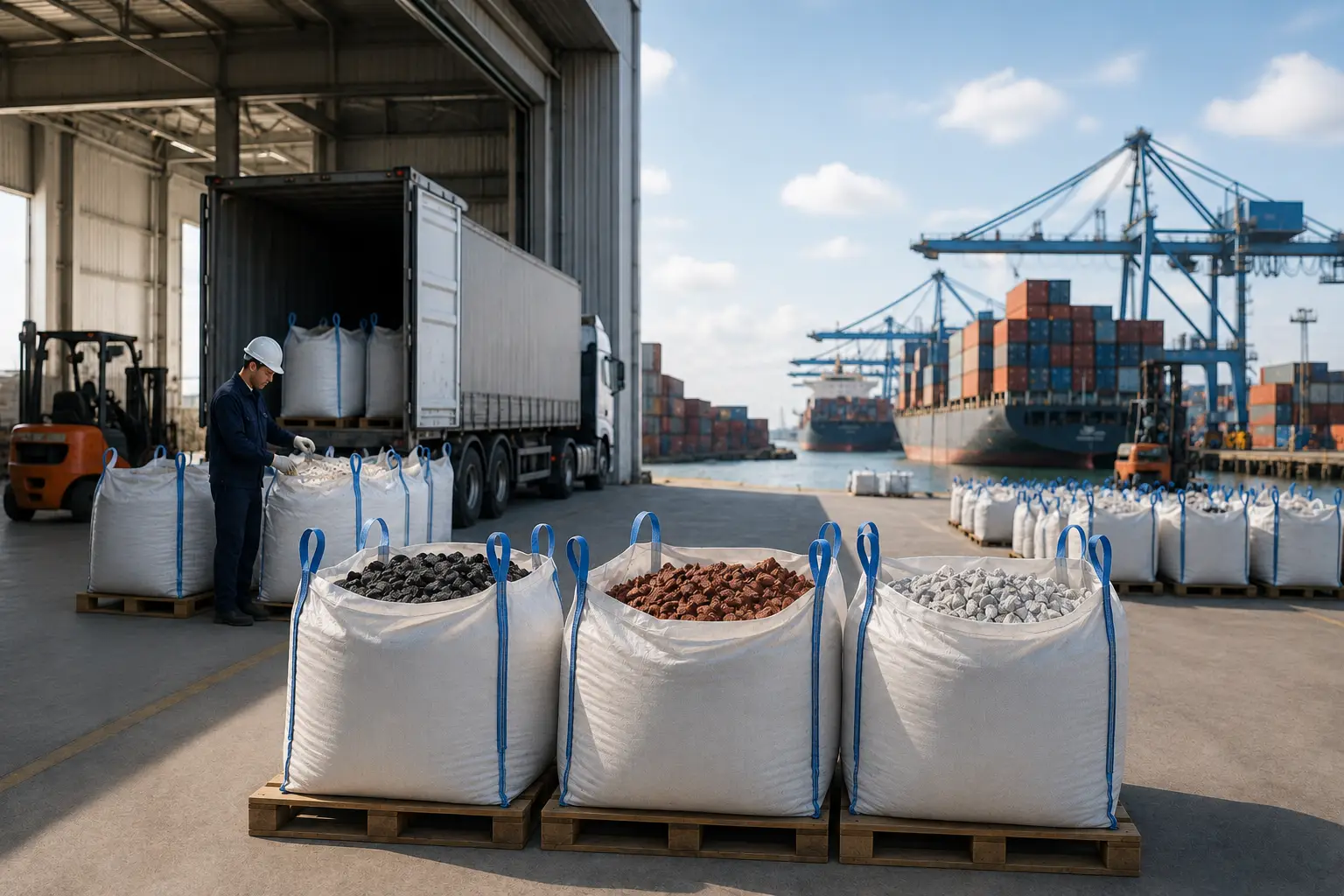
The vast majority of FIBCs used in the United States are manufactured overseas. India and China account for the largest share of imports, with Vietnam, Turkey, and parts of Southeast Asia filling in behind them. A smaller number of bags come from domestic manufacturers or from Mexico under the USMCA framework. If you buy bulk bags, you’re choosing between these sourcing lanes whether you think about it consciously or not.
The decision usually gets framed as a simple cost question: overseas bags are cheaper per unit, domestic bags ship faster. That framing is accurate at the surface but incomplete in ways that cost buyers money when the details catch up. Unit price is one line in a landed cost calculation that also includes tariffs, ocean freight, warehousing, quality control overhead, and the cost of being wrong when a shipment arrives late or out of spec.
This article breaks the sourcing decision into its three core variables: lead time, quality control, and total cost. Each one behaves differently depending on whether you’re buying domestic, importing directly, or working through a distributor that sources overseas and warehouses locally. If you’ve already read Codefine’s guide on how tariffs affect FIBC costs, this picks up where that article leaves off and puts tariffs into the broader sourcing picture.
Domestic FIBC production, when stock is available, can ship within one to two weeks. Custom orders from a US-based manufacturer typically run three to five weeks depending on the bag’s construction complexity, fabric availability, and the plant’s production queue. That’s the fastest path from order to delivery, and it’s the main selling point for domestic sourcing.
Overseas manufacturing follows a longer timeline. Production in India or China takes roughly six to eight weeks for custom orders. On top of that, you add one to two weeks for inland transport to the port, three to six weeks of ocean transit depending on origin (China is closer to US West Coast ports; India routes through the Suez Canal to East Coast ports or takes the longer Pacific route), and another one to two weeks for port discharge, customs clearance, and domestic rail or truck delivery. Total door-to-door from an overseas factory runs 12 to 18 weeks for a new custom order. Repeat orders on established specs move faster because the factory doesn’t need a new sample approval cycle, but you’re still looking at 10 to 14 weeks in most cases.
Mexico sits in between. Production lead times are comparable to Asian manufacturers, but the ocean transit leg drops out entirely. Overland trucking from northern Mexico to the US interior takes two to four days. Total lead time for a Mexican-sourced FIBC runs eight to ten weeks for custom orders, and bags enter under USMCA with zero additional tariff if they meet rules-of-origin requirements.
The lead time numbers above describe a clean run. Port congestion, customs holds, container shortages, and factory delays can stretch any of these timelines by weeks. Buyers who forecast FIBC demand and plan ahead absorb these disruptions more easily than buyers who order reactively. That planning buffer is the real variable that separates sourcing strategies that work from ones that leave you scrambling.
Most US-based FIBC distributors don’t manufacture anything. They source bags from overseas factories, ship them in bulk to domestic warehouses positioned near major markets, and fulfill orders from local stock. This model gives you the unit cost advantage of overseas manufacturing with lead times that look closer to domestic. For standard bag configurations, a distributor with warehouse stock can ship within days.
The tradeoff is that the distributor decides what goes into the warehouse. If your spec matches their stocked inventory, the system works well. If you need a custom configuration, the order still routes through an overseas factory and follows the full import timeline. And if the distributor’s demand forecasting misses, they run out of your bag type and you wait regardless of where their warehouse sits.
A distributor relationship with domestic warehousing is a form of inventory risk transfer. You’re paying someone else to carry stock and absorb the lead time of overseas production on your behalf. That has value, but it also means you’re one step removed from the factory, which affects how much control you have over quality and spec changes. For operations that need a stable, low-risk supply chain, understanding who actually holds the inventory and how deep their buffer runs matters more than where the warehouse is on a map.
Quality control looks different depending on how many links sit between you and the factory floor.
When you buy from a domestic manufacturer, your QC options are direct. You can visit the plant, inspect production runs, review test reports in real time, and resolve issues face to face. If a bag comes in out of spec, the feedback loop is short. For operations that run UN-certified bulk bags or food-grade packaging where compliance documentation is critical, that proximity has real value. FIBC test methods like drop testing, top-lift testing, and topple testing can be witnessed and verified without a 14-hour flight.
Overseas factories have closed the quality gap significantly over the past decade. Many facilities in India, China, and Vietnam now hold BRC, AIB, or ISO certifications and produce FIBCs that meet every international standard. The quality question isn’t whether overseas factories can build to spec. It’s whether you have a reliable way to verify that they did on your specific order.
Pre-shipment inspection is the standard QC mechanism for overseas sourcing. A third-party inspector visits the factory after production, pulls samples from the finished lot according to an AQL (Acceptable Quality Level) plan, and checks dimensions, weight, seam strength, print accuracy, liner fit, and documentation. The inspector issues a pass or fail report before the shipment loads onto a container. If it fails, you catch the problem before it’s on the water. If you skip pre-shipment inspection to save the fee, you’re betting that every bag in every container meets spec, and you won’t know whether you won that bet until the shipment arrives at your facility weeks later.
Distributors that source overseas handle QC in different ways. Some run their own inspection programs at the factory level. Others rely on the manufacturer’s internal quality systems and inspect at the warehouse when bags arrive domestically. The gap between those two approaches matters. A distributor who catches defects at the factory can reject and rework before shipping. A distributor who catches defects at the warehouse is already sitting on freight cost, tariff, and lead time for bags that may not be usable. When you’re evaluating what to look for in an FIBC supplier, ask where in the chain their quality checks happen.
Unit price is the number that gets the most attention, and it’s the number that obscures the most. An overseas FIBC might cost 40% to 60% less than a domestic bag at the factory gate. By the time you add the rest of the cost stack, the gap narrows, and in some configurations it closes almost entirely.
The landed cost of an imported FIBC includes the factory price, inland freight to port, ocean freight (which fluctuates with container rates and fuel surcharges), marine insurance, the base 8.4% import duty under HTS code 6305.32.0010, any applicable Section 301 tariffs (which have reached 25% or higher on Chinese-origin FIBCs), customs brokerage fees, port handling charges, and domestic freight from port to warehouse or end user. Some of those costs are fixed per unit. Others move with market conditions. Ocean freight rates, for example, can swing by a factor of three or four between a soft market and a capacity-constrained peak.
Domestic bags skip the import cost stack entirely. The unit price is higher, but the only freight cost is a truck from the factory or warehouse to your facility. No tariff, no customs, no ocean rate exposure. For buyers who factor in the total cost of reducing packaging costs without sacrificing quality, the domestic option sometimes wins on small orders or rush requirements where the per-unit savings of an import don’t cover the logistics overhead.
Tariff volatility adds a risk dimension that doesn’t show up in a static cost comparison. Section 301 tariffs on Chinese FIBCs have changed multiple times, and the current rate environment could shift again with trade policy changes. Buyers who lock in pricing with a Chinese manufacturer may find their landed cost jumping by double digits if a new tariff round hits between order placement and delivery. Sourcing from India, Vietnam, or Mexico reduces that specific exposure, but each origin carries its own trade policy and logistics variables.
Bags, PE liners, and container liners don’t always come from the same source, and there are good reasons to split them.
PE liners are lighter, ship more compactly, and have a simpler manufacturing process than woven PP bags. The cost advantage of overseas liner production is smaller in absolute terms, which means the logistics and tariff overhead eat into the savings more quickly. Some buyers source their bags overseas and their polyethylene (PE) liners domestically or regionally to keep lead times short on a component that’s consumed every cycle (liners are single-use, even inside multi-trip FIBCs).
Container liners sit in yet another category. A container liner for a 20 ft or 40 ft shipping container is a high-volume, single-use product that cycles on the same schedule as the container itself. Stocking them domestically near port operations or export facilities keeps your container turnaround time tight and avoids the irony of waiting weeks for a liner import that’s supposed to speed up your shipping cycle.
The takeaway for procurement teams: evaluate each packaging component on its own sourcing logic. The bag, the liner, and the container liner may each land on a different origin and a different supplier, and that’s often the right answer. Consolidating everything to one source for simplicity can leave you overpaying on some components and under-serving your supply chain on others.
The strongest sourcing positions split risk across at least two supply lanes. A buyer who sources from a single overseas factory has the best unit price and the most fragile supply chain. If that factory has a production problem, a port closure delays the shipment, or a tariff change reprices the order mid-transit, the buyer has no fallback.
A dual-source model pairs overseas manufacturing (for the cost advantage on high-volume standard specs) with either domestic production or a distributor’s local inventory (for rush orders, custom specs, and buffer stock). You order the bulk of your annual volume overseas with enough lead time to absorb transit variability. You keep a safety stock position domestically to cover demand spikes, production shortfalls, or shipping delays.
Codefine’s guide on seasonal demand planning for bulk packaging applies directly here. If your usage peaks in certain months (harvest season, construction season, year-end production pushes), your overseas orders need to leave the factory months ahead of that peak. Your domestic buffer covers the gap if the timing doesn’t line up perfectly.
Review your sourcing annually against actual lead times, actual defect rates, and actual landed costs. The numbers shift. Ocean rates move. Tariff policy changes. Factory performance varies year over year. A sourcing strategy built on last year’s data and never updated is a sourcing strategy that’s quietly costing you money. Use your FIBC buying checklist as the starting framework, and layer in the sourcing variables covered here to build a plan that accounts for cost, time, quality, and risk at the same time.
Codefine has been manufacturing woven polypropylene packaging since the 1950s and supplies FIBCs, PE liners, and Bulksaver® container liners to operations across multiple industries. With both manufacturing capacity and domestic warehousing, Codefine gives buyers the flexibility to plan ahead on standard specs while maintaining the ability to respond to urgent requirements without the lead time exposure of a purely overseas supply chain.
Every bag ships with full material composition documentation, UN certification where applicable, and the spec traceability that procurement teams need for audit and compliance purposes. Explore the full product range or contact Codefine to discuss how to build a sourcing plan that balances cost, lead time, and quality for your operation.
Custom orders from India or China typically run 12 to 18 weeks door-to-door on a first order, including production, ocean transit, customs, and domestic delivery. Repeat orders on established specs can come in closer to 10 to 14 weeks. Port congestion, container shortages, and customs holds can push any of these timelines longer.
Not inherently. Major FIBC factories in India, China, and Vietnam hold BRC, AIB, and ISO certifications and produce bags that meet the same international standards as domestic manufacturers. The quality risk is about verification, not capability. Buyers who run pre-shipment inspections and work with factories that have third-party certifications get the same quality at a lower cost. Buyers who skip QC steps are the ones who run into problems.
The base import duty on FIBCs under HTS code 6305.32.0010 is 8.4%. Chinese-origin FIBCs are also subject to Section 301 tariffs that have reached 25% or higher, bringing the total to over 30% in some cases. Bags from India, Vietnam, and Mexico (under USMCA) face lower or zero additional tariffs, though rates can change with trade policy shifts. Always confirm current rates before committing to an order.
Not necessarily. Bags, PE liners, and container liners have different cost structures, lead time profiles, and consumption rates. PE liners are single-use and consumed every cycle, so keeping them on a shorter supply chain (domestic or regional) can make sense even if your bags come from overseas. Evaluate each component separately and source where the landed cost, lead time, and quality tradeoffs line up best for that specific product.
Diversify your sourcing across at least two countries of origin so a tariff change on one lane doesn’t reprice your entire supply. Maintain domestic safety stock to cover gaps during transitions. Monitor trade policy developments and build tariff scenarios into your annual procurement planning. Work with suppliers who have manufacturing relationships in multiple countries and can shift production if one origin becomes unfavorable.
See how our products can improve your operations and drive your success.
Get in touch to find out how Codefine can support your business with tailored solutions and expert guidance.