
Home » Posts Page » Blog » FIBC Bags for Lithium, Cobalt, and Rare Earth Minerals: Handling Considerations for the EV Supply Chain
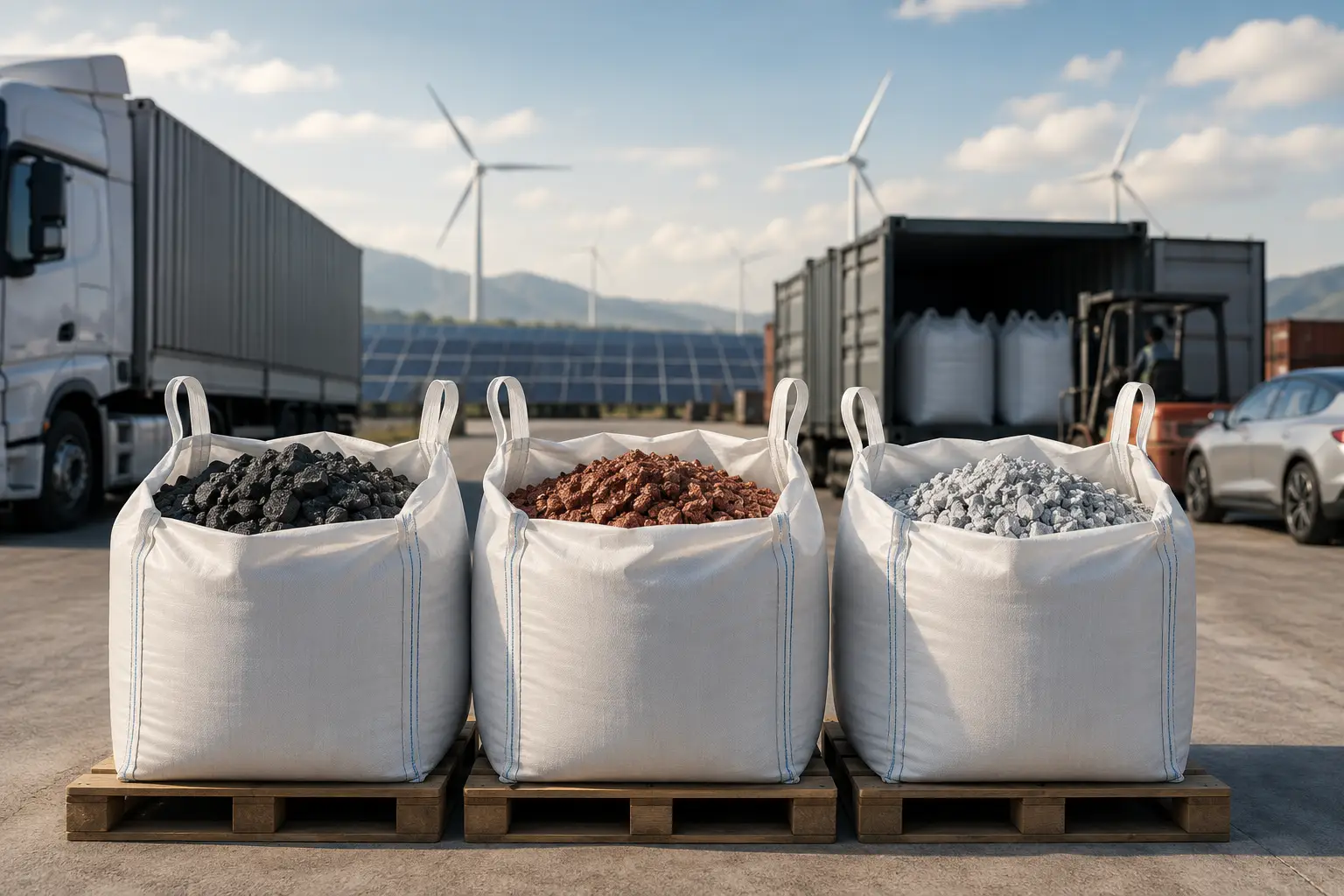
The materials that go into EV batteries and electric motor magnets don’t show up at cathode plants and cell manufacturers in finished form. They arrive as powders, flakes, concentrates, and hydroxides, packed in bulk and shipped from mines and refineries across multiple continents. Lithium carbonate, lithium hydroxide, cobalt sulfate, nickel sulfate, manganese dioxide, and rare earth oxides like neodymium and dysprosium all move through the supply chain in intermediate bulk packaging before they reach the production lines that turn them into battery cells and permanent magnets.
FIBCs are the standard packaging format for most of these materials at the bulk stage. But the spec requirements for EV mineral packaging are more demanding than traditional mining products like sand, gravel, or construction aggregite. These materials are chemically reactive, hygroscopic, toxic, or classified as hazardous goods. Some are all four. Purity standards are tight because contamination at the packaging stage can cascade through cell manufacturing and affect battery performance downstream. And the traceability expectations in the EV supply chain now reach all the way back to the mine, which means the packaging itself becomes part of the documentation trail.
This article covers the FIBC considerations specific to lithium compounds, cobalt compounds, and rare earth minerals as they move through the EV supply chain. If your operation handles any of these materials in bulk, the bag spec decisions covered here affect product integrity, regulatory compliance, and your position in a supply chain where contamination and traceability failures carry consequences far beyond a rejected shipment.
Traditional mining products like iron ore, coal, and aggregate are forgiving on packaging. They tolerate moisture, don’t react with polypropylene, and contamination thresholds are measured in percentages, not parts per million. EV battery minerals operate under a completely different set of constraints.
Lithium hydroxide is corrosive (Class 8 under DOT hazmat classification) and reacts with atmospheric moisture and carbon dioxide, forming lithium carbonate on its surface. That reaction changes the material’s chemical properties in ways that affect cathode synthesis. Lithium carbonate is less reactive but still hygroscopic enough that unprotected exposure during storage degrades purity. Both compounds require UN-certified bulk bags when shipped in hazardous goods quantities, and the UN marking codes on the bag need to match the specific classification and packing group of the compound being transported.
Cobalt sulfate and other cobalt compounds carry toxicity classifications (Class 6.1 in many formulations) and are subject to strict occupational exposure limits. The powder is fine enough to become airborne during filling and discharge, which creates both a health hazard and a contamination control problem. Nickel sulfate shares similar toxicity concerns. Both materials need packaging that minimizes dust release during handling and provides a sealed barrier during transit.
Rare earth oxides present yet another profile. Neodymium, praseodymium, and dysprosium oxides are fine powders with high specific gravity, which puts concentrated stress on bag seams and lift loops. Some rare earth compounds are mildly pyrophoric (Class 4.2) in finely divided form, adding a fire hazard dimension. The purity requirements for rare earths going into permanent magnet production are extreme, often requiring 99.5% or higher, which means any contamination from the packaging material itself, from residue of a previous product, or from moisture exposure can push the material out of spec.
Moisture management for EV minerals goes beyond preventing caking. For lithium hydroxide, moisture triggers a chemical reaction that changes the product’s composition. For rare earth oxides headed to magnet sintering, absorbed moisture creates oxidation during thermal processing that degrades magnetic properties. The packaging isn’t just keeping the product dry; it’s preserving the product’s chemical identity.
A sealed polyethylene (PE) liner inside an uncoated FIBC provides the primary moisture barrier. For lithium and cobalt compounds, the liner thickness should be at the upper end of the range (100 micron or heavier) because these materials are packed dense and the weight creates pressure points where thinner film can develop pinholes. The liner needs to seal completely at the top after filling, not just fold over, because even small gaps allow enough atmospheric exchange to start surface reactions on hygroscopic compounds.
Cross-contamination between products is a more serious concern here than in most FIBC applications. A bag that previously held cobalt sulfate and then gets refilled with lithium hydroxide introduces cobalt contamination at levels that battery cathode manufacturers will reject. Single-trip bags eliminate this risk entirely. Multi-trip bags are workable only in closed-loop systems where the same product goes into the same bag every cycle, with liner replacement and interior inspection between trips. Given the value of these materials (lithium carbonate trades at thousands of dollars per metric ton; cobalt and rare earth oxides can be significantly higher), the cost of a single-trip FIBC is negligible relative to the cost of a contaminated load.
Understanding the FIBC requirements for hygroscopic materials applies directly to lithium and rare earth packaging, with the added constraint that the purity threshold for rejection is much tighter than in traditional chemical applications.
Several EV battery minerals trigger hazardous goods classification under DOT 49 CFR and international transport regulations (ADR, IMDG, IATA DGR). The classification determines whether you need a UN-certified FIBC and which packing group applies.
Lithium hydroxide, monohydrate is classified as Class 8 (corrosive), Packing Group II. That requires an FIBC tested and marked to at least Y-rating standards under UN construction type 13H (woven polypropylene). The packaging requirements for hazardous goods specify the testing protocol the bag must pass, including drop tests, stacking tests, and top-lift tests at the packing group’s severity level. Lithium carbonate, in many formulations, does not carry a hazardous classification and can ship in non-UN FIBCs, though moisture protection remains critical.
Cobalt compounds vary by formulation. Cobalt sulfate is typically Class 6.1 (toxic), PG III, which requires a Y-rated or Z-rated UN FIBC. Cobalt chloride may carry additional classifications. The proper shipping name and UN number on the bag label must match the specific compound, not a generic “cobalt product” descriptor. You can verify the alignment by reading the FIBC label against the safety data sheet for the material.
Rare earth compounds have variable classifications. Most rare earth oxides in bulk powder form are not classified as hazardous for transport. Certain finely divided forms (particularly cerium and lanthanum) can be Class 4.2 (spontaneously combustible) below specific particle sizes. If your material falls into that category, you need a UN-certified bag and you need to confirm that the hazardous goods classification and FIBC type are matched correctly for the specific compound and particle size distribution you’re shipping.
Fine mineral powders generate static charge during pneumatic filling, gravity discharge, and even during transit when particles shift against each other and against the bag wall. For most EV minerals, the static risk centers on the filling environment more than on the product itself.
If you’re filling cobalt sulfate or rare earth oxide powder in a facility where flammable solvents, dusts, or gases are present anywhere in the filling zone, Type A bags (standard woven PP with no static protection) are not appropriate. The anti-static bulk bags guide walks through the classification system. For mixed-use facilities where the filling line might handle both inert and flammable products, Type C (conductive, grounded) or Type D (static-dissipative without grounding) bags give you a safety margin that covers the worst-case environmental scenario.
Lithium compounds present a distinct static concern. Lithium hydroxide dust in contact with moisture can generate heat, and if a static discharge occurs near accumulated dust, the combination creates an ignition pathway. The filling area for lithium compounds should be humidity-controlled (to limit the hygroscopic reaction) and the bag should be at least Type B (antistatic with breakdown voltage below 6 kV) for most operations. Codefine’s comparison of Type C vs. Type D static protection helps you match the right classification to your specific facility conditions.
The EV supply chain is under growing pressure for end-to-end traceability. EU Battery Regulation requirements, US Inflation Reduction Act provisions on critical mineral sourcing, and automaker ESG commitments all push documentation requirements upstream to the mine and refinery level. Packaging is part of that chain.
For FIBC shipments of EV minerals, the documentation trail typically includes the material’s certificate of analysis (purity, particle size, moisture content), the bag’s UN certification marks (if applicable), lot traceability linking the bag to the production batch, and sometimes chain-of-custody documentation that traces the mineral from extraction through refining and packaging. A bag with proper UN markings provides part of this trail, but buyers in the EV space increasingly require packaging documentation that goes beyond the regulatory minimum.
Single-trip bags simplify the traceability picture. Each bag carries one product from one production lot, and the bag itself becomes a one-to-one record. Multi-trip bags in reuse programs introduce ambiguity into the documentation unless your tracking system ties each bag’s serial number to every product lot it has carried and every inspection it has passed between trips.
Start with the material’s safety data sheet. Identify the hazardous goods classification (if any), the hygroscopic sensitivity, the particle size distribution, and the purity specification your customer requires. Those four data points drive every other packaging decision.
For hazardous materials, match the UN FIBC certification to the packing group. For hygroscopic compounds, spec a sealed PE liner at 100 micron or heavier inside an uncoated outer bag. For fine powders in facilities with any flammable atmosphere risk, step up to Type B or higher static classification. For high-value materials where contamination tolerance is measured in parts per million, use single-trip bags and fresh liners without exception.
The FIBC buying checklist provides the structural framework, and the packaging solutions for the mining industry article covers broader mining packaging considerations. For EV minerals specifically, the spec conversation needs to start with purity and traceability, not just load capacity and cost per bag. The materials going through your bags are among the most strategically important and tightly specified commodities in the global industrial supply chain right now, and the packaging needs to reflect that.
Codefine manufactures UN-certified FIBCs and PE liner systems for hazardous and high-purity mineral applications, including the Class 8, Class 6.1, and Class 4.2 classifications that cover lithium hydroxide, cobalt compounds, and certain rare earth formulations. Every bag is built with an uncoated PP outer and a sealed PE liner at the thickness required for dense, hygroscopic mineral powders where moisture contact changes the product’s chemistry. For EV battery supply chains where contamination tolerance is measured in parts per million and traceability runs from mine to cathode plant, Codefine provides full material composition documentation and lot traceability alongside UN marking compliance. Contact Codefine to discuss packaging specs for your specific mineral compounds and purity requirements.
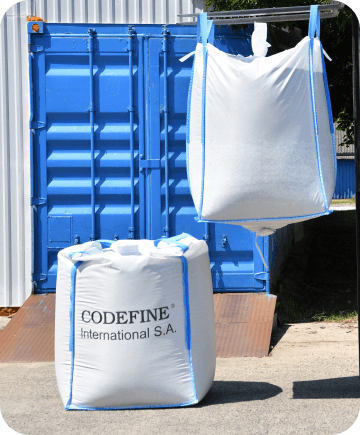
Lithium hydroxide is classified as Class 8 (corrosive), Packing Group II, and requires a UN-certified FIBC with at least a Y-rating. Lithium carbonate is typically not classified as hazardous for transport in most formulations and can ship in non-UN bags, though moisture protection is still critical. Always check the safety data sheet for the specific compound and concentration you’re shipping.
Type A (no static protection) is acceptable only if the filling and discharge environment has no flammable dust, vapor, or gas present. For mixed-use facilities or environments where flammable atmospheres are possible, step up to Type C (grounded conductive) or Type D (static-dissipative). For lithium compounds, Type B at minimum is recommended because of the interaction between lithium dust, moisture, and potential heat generation.
Purity specifications for battery-grade lithium, cobalt, and rare earth compounds are extremely tight, often requiring 99% or higher. Cross-contamination from a previous product, even at trace levels, can push the material out of spec and lead to rejection by cathode or cell manufacturers. Single-trip bags with fresh PE liners eliminate the contamination risk that comes with reuse. Given that the value of these materials runs to thousands of dollars per metric ton, the incremental cost of a new bag is negligible compared to the cost of a contaminated load.
Lithium hydroxide reacts with atmospheric moisture and CO2, forming lithium carbonate on its surface. This changes the material’s chemical properties and degrades its value for cathode production. The FIBC should have a sealed PE liner at 100 micron or heavier, with a complete seal at the top after filling. The uncoated outer bag allows any trapped moisture between the liner and bag wall to escape without contacting the product. Short exposure windows during filling and sealing should be minimized in humidity-controlled environments.
EU Battery Regulation and US IRA provisions are pushing documentation requirements upstream to the packaging level. Buyers increasingly expect lot traceability linking the bag to the production batch, certificates of analysis matching the material to the bag, and sometimes chain-of-custody documentation from mine to refinery to packaging. UN markings on the bag provide part of this trail. Single-trip bags simplify traceability because each bag maps one-to-one to a single product lot.
See how our products can improve your operations and drive your success.
Get in touch to find out how Codefine can support your business with tailored solutions and expert guidance.