
Home » Posts Page » Blog » Hazardous Goods Classifications and Which FIBC Types Apply

The mistake is rarely deliberate. Most procurement teams know they need UN-certified bags for dangerous goods shipments, but the gap between knowing that and selecting the right code, the right packing group rating, the right liner combination – that gap is wider than the certificate itself suggests. A bag marked 13H3/Y/250/S/19/USA/ABC123 carries several pieces of information, and getting any one of them wrong against the product being shipped can stop a container at port.
This article works through the UN classification framework as it applies to FIBCs: what the hazard classes mean, why FIBCs cannot carry Packing Group I materials, how the four bag types differ, and how to match a specific hazardous product to the bag construction that will pass inspection.
Every dangerous good carried in international commerce sits in one of nine hazard classes defined by the UN Recommendations on the Transport of Dangerous Goods – the document the industry calls the Orange Book. Class 1 covers explosives, Class 2 gases, Class 3 flammable liquids, Class 4 flammable solids and substances that emit flammable gas in contact with water, Class 5 oxidizers and organic peroxides, Class 6 toxic and infectious substances, Class 7 radioactive materials, Class 8 corrosives, and Class 9 miscellaneous dangerous goods, including environmentally hazardous substances.
For FIBC operations, the classes that come up most often are Class 4, Class 5, Class 6, Class 8, and Class 9. FIBCs are designed for dry, solid, or granular products, so the liquid and gas classes are mostly out of scope. The hazard class on your safety data sheet is the first input into FIBC selection.
Within most hazard classes, the UN system divides materials further into three packing groups based on the degree of danger. Packing Group I covers high danger, Group II medium danger, and Group III low danger. The assignment is based on properties such as toxicity, corrosivity, flammability, and reactivity – and it determines what level of packaging performance is required. A Group III material can travel in Group III packaging or higher-rated packaging, but the reverse is not true: a bag rated only for Group III cannot legally carry a Group II material, regardless of how strong the bag looks.
Flexible intermediate bulk containers are not approved for Packing Group I materials. For solids, the X marking is reserved for rigid IBCs. In practice, FIBCs are certified to Y (Groups II and III) or Z (Group III only), and shipping a Group I material in any FIBC creates a compliance violation that customs is almost guaranteed to catch. If your product is classified as Packing Group I, you need rigid packaging such as drums or rigid IBCs. This is a regulatory boundary set by the Orange Book and adopted into national rules like the US DOT’s 49 CFR Parts 171 through 180.
All four FIBC types share the same code prefix. The 13 indicates a flexible bulk container, H indicates woven plastic construction (polypropylene for FIBCs), and the final digit indicates construction details. A 13H1 is an uncoated woven polypropylene with no liner. A 13H2 is a coated woven polypropylene with no liner. A 13H3 is an uncoated woven polypropylene with a polyethylene liner. A 13H4 is coated woven polypropylene with a PE liner. Two variables generate the four types: whether the woven fabric carries an external coating, and whether the bag includes an internal PE liner.
A 13H1 bag suits coarse granular hazardous materials that do not require a moisture or dust barrier. A 13H2 holds back fine powders that would dust through a bare weave, and the coating provides some moisture resistance. A 13H3 uses a PE liner to contain fine powders and provides significantly better moisture protection than coating alone. A 13H4 combines coating and lining for products requiring the highest containment available within the FIBC framework.
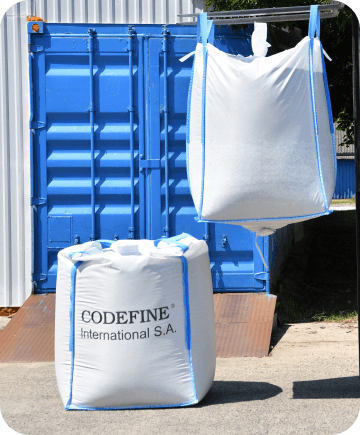
Codefine manufactures FIBCs with inner PE liners and uncoated outer fabric (the 13H3 configuration), which suits the majority of food, chemical, agricultural, and industrial applications where a liner provides the necessary product barrier.
A full UN marking on a hazardous-goods FIBC contains seven pieces of information: the UN packaging symbol, the bag type code (13H1 through 13H4), the packing group rating (Y or Z), the maximum gross mass or stacking load in kilograms, the year of manufacture, the country code of the certifying authority, and the manufacturer’s identification. The marking 13H3/Y/250/S/19/USA/ABC123 reads as a 13H3 construction, Y-rated for Packing Groups II and III, with a 250 kg stacking load, certified for solids, manufactured in 2019, certified in the USA by manufacturer ABC123. For a complete breakdown of how to decode every element of that marking, the UN markings for FIBC bulk bags guide covers each field in detail.
Selection starts with the physical form of the product. Coarse granular materials in Class 4 or Class 5 that do not produce significant dust can move in 13H1 or 13H2 bags. Fine powders in the same classes require a 13H3 or 13H4 because the dust generated during fill and discharge cannot escape into the work environment or the transport vehicle. Many Class 6 toxic solids and Class 8 corrosive solids fall into the powder category and require lined construction by default. For a full overview of chemical containment requirements and handling guidelines, that resource goes deeper on product-specific considerations.
Some hazardous solids are stable under normal conditions but generate hazardous conditions when exposed to moisture. Class 4.3 covers substances that emit flammable gas in contact with water; for those materials, the liner is the primary containment through any humid transit. A 13H3 or 13H4 with verified liner seal integrity and a properly closed liner spout is the required specification. For corrosive solids in Class 8 that are hygroscopic, the liner prevents the product from absorbing moisture and degrading or generating reactive conditions during a long ocean transit. Moisture-resistant FIBC guidance covers liner seal requirements and the practical steps to verify integrity before shipment.
Coated versus uncoated fabric is often a matter of operator preference rather than strict regulatory requirement. A 13H3 and a 13H4 provide similar containment for most powdered hazardous products because the liner does the primary work. The coating adds a secondary barrier and reduces product residue working into the woven fabric, which matters for traceability and cleanability in closed-loop systems. For most applications where the liner alone provides adequate containment, the uncoated 13H3 is the more common and lower-cost option.
UN certification addresses mechanical containment but does not address electrostatic discharge risk. For flammable products or for any product filled or discharged in atmospheres containing flammable dust or vapor, an additional specification layer applies: the FIBC static type, running from Type A (no static protection) through Type B, Type C, and Type D. Type A bags suit only non-flammable products in non-flammable atmospheres. Type B prevents the buildup of voltages high enough to cause propagating brush discharges but does not provide complete static protection. Type C bags are conductive and require grounding during fill and discharge. Type D bags use static dissipative fabric that safely dissipates charges without requiring a ground connection.
For UN-classified flammable solids or any product handled in a Zone 21 or Zone 22 dust atmosphere, Type C or Type D bags are the appropriate selection. Type C depends on the operator connecting the grounding tab at every fill and discharge cycle; a missed connection eliminates the safety margin entirely. Type D works without grounding, removing the operator-dependent step from the safety logic. For operations where grounding discipline cannot be guaranteed, Type D is often the practical choice even at a higher per-bag cost. A full breakdown of when each type applies is available in the anti-static bulk bags guide.
A Y-rated FIBC has been tested and certified to performance standards adequate for Packing Group II and Packing Group III materials. The drop test is performed from 1.2 meters, the stack test is performed to the rated stacking load, and the minimum safety factor is 6:1 for hazardous goods bags compared to 5:1 for non-hazardous bags. Understanding what those FIBC safety factors mean in practice helps procurement teams verify that a bag’s rated capacity actually covers their fill weight and storage configuration. A Y-rated bag covers the largest share of solid hazardous goods shipments because most Class 4 through Class 9 solids fall into Packing Group II or III.
A Z-rated FIBC is certified only for Packing Group III materials. The testing requirements are less demanding than for Y bags, which lowers the manufacturing cost. For operations shipping only Group III materials with confidence that the classification will not change, the Z-rated bag is adequate. For operations where the same bag specification might apply to different products over time, the Y rating provides flexibility and avoids the risk of accidentally loading a Group II material into a Group III bag.
A Group II material in a Z-rated bag is a regulatory violation, whether discovered at customs, by a carrier audit, or after an incident. The penalty in most jurisdictions includes fines, refused shipments, and in cases involving environmental release or worker injury, criminal liability for the shipper. Carriers screen documentation for these mismatches and will refuse loads where the bag certification does not cover the declared product classification. For a broader look at what packaging with UN approvals for dangerous goods actually requires at the documentation level, that article covers the shipper’s obligations in detail.
A common error involves selecting a 13H1 bag based on cost without verifying that the product can travel safely in uncoated, unlined construction. Fine powders in 13H1 bags will dust during fill and discharge and arrive with measurable product loss through the weave. For hazardous goods, this becomes a worker exposure problem: dust escaping the bag means the operator handling it is exposed to a regulated hazardous material that was supposed to be contained. The correction is to specify the bag against the actual product properties from the safety data sheet. Reviewing the FIBC buying checklist before placing an order catches most of these gaps before they become compliance problems.
This error occurs when procurement orders to a specification set under one product assumption and the product is subsequently reclassified. The cost saving on the Z bag is small – often single-digit percentages over a Y bag of the same construction – and the compliance risk is total: any Group II shipment in a Z bag is non-compliant from the moment it is filled. Procurement teams handling multiple hazardous products through the same FIBC line benefit from defaulting to Y-rated bags unless there is a clear cost case for Z-rated bags on a specific product.
Bag specification errors surface at customs inspection, during a carrier audit, or after an incident triggers a regulatory investigation. None of these is an ideal moment to find out. All of them are expensive, ranging from a held shipment and demurrage charges at the lower end to facility-wide regulatory action at the upper end. A receiving inspection process that verifies the UN marking on every bag delivery against the product classifications the bags are intended for catches almost all of these errors at the cheapest possible moment to fix them. The guide to safely handling FIBC bulk bags includes receiving inspection steps that work as a practical quality gate.
Bag specification errors surface at customs inspection, during a carrier audit, or after an incident triggers a regulatory investigation. None of these is an ideal moment to find out. All of them are expensive, ranging from a held shipment and demurrage charges at the lower end to facility-wide regulatory action at the upper end. A receiving inspection process that verifies the UN marking on every bag delivery against the product classifications the bags are intended for catches almost all of these errors at the cheapest possible moment to fix them. The guide to safely handling FIBC bulk bags includes receiving inspection steps that work as a practical quality gate.
The decision starts with the safety data sheet for the product. The SDS gives you the UN number, the hazard class, the packing group, and the proper shipping name. With those four pieces of information, you can match the product to the bag specification needed.
Take the packing group first: a Group I material cannot move in an FIBC at all; a Group II material needs a Y-rated bag; a Group III material can use Y or Z, depending on operational preference. Then move to construction: a fine powder or moisture-sensitive product needs a lined bag (13H3 or 13H4); a coarse granular product without moisture sensitivity can use 13H1 or 13H2. Then check the static type, and verify the maximum gross mass and stacking load on the certification cover your fill weight and storage configuration. For operations running different types of FIBCs across multiple product lines, mapping each product to its required specification before ordering prevents the classification drift that drives most compliance failures.
A UN-certified FIBC is certified for a specific product class, a specific packing group, a specific maximum gross mass, and a specific stacking load. Using the bag outside any of those parameters voids the certification. Beyond the UN marking, the bag must also be matched to the static risk of the product and the operating environment. A standard Type A UN-certified bag is not appropriate for a flammable powder, even if the bag’s mechanical certification covers the product class and packing group. The static type is a separate specification layer that the UN marking itself does not address.
Codefine manufactures UN-certified FIBCs in the 13H3 configuration – uncoated outer fabric with an inner PE liner – with third-party-tested certification documentation that matches the markings on the bag. If you are reviewing your current hazardous-goods FIBC specification, qualifying a new bag for a different product class, or working through the static type requirements for a flammable solid, the Codefine team can work through the selection with you. Get in touch to start the conversation.
See how our products can improve your operations and drive your success.
Get in touch to find out how Codefine can support your business with tailored solutions and expert guidance.